Craft Around the Country

Repurposed Materials, Reclaimed History

In Gloria Martinez-Granados’s cross-stitched portraits, the stories of Latino laborers stretch across generations.

By Jacquelin Huynh Young
March 2, 2026

Photo by Alonso Parra, courtesy of the artist

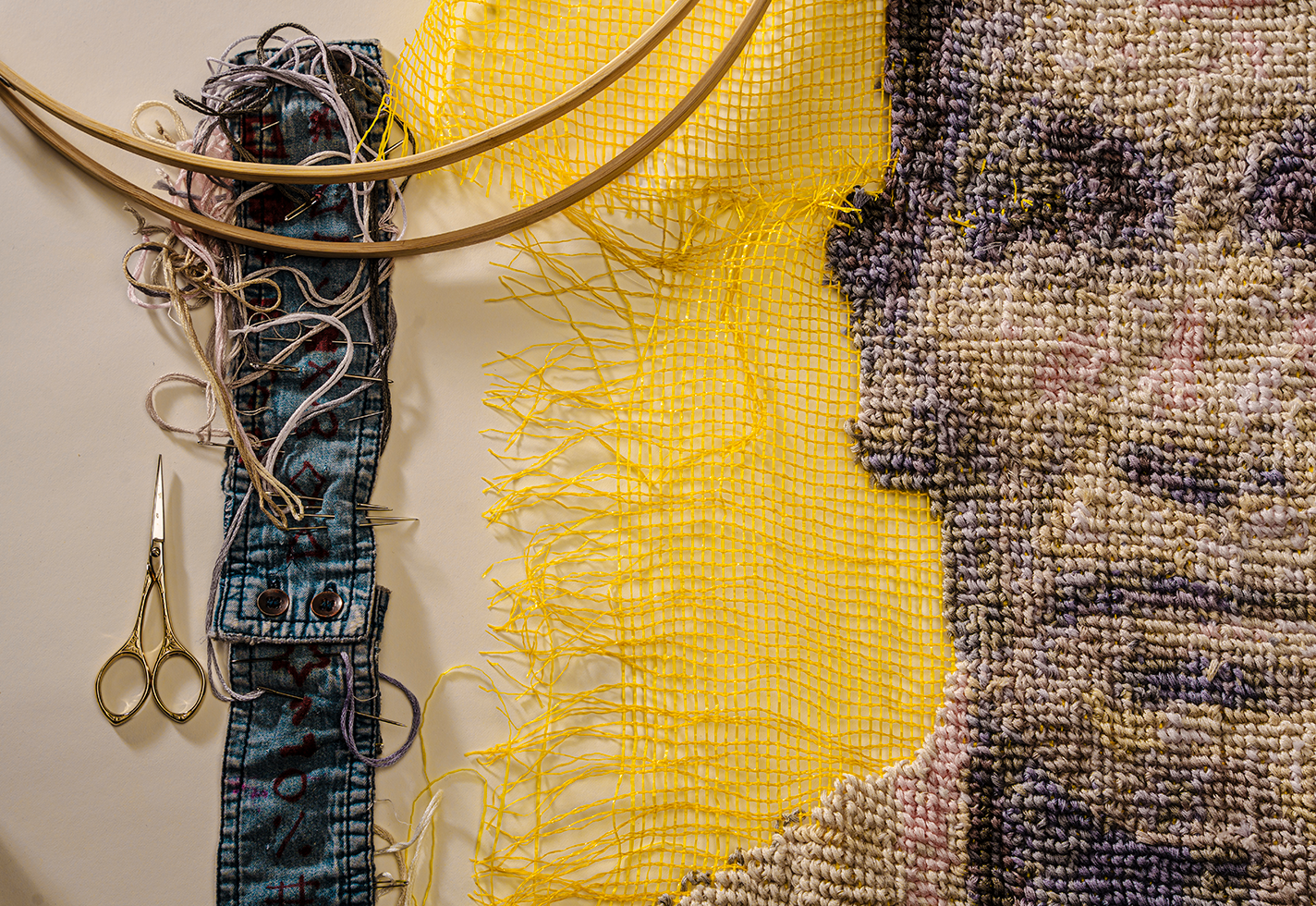
A detail shot of Gloria Martinez-Granados's 2024 cross-stitched portrait Retrato de Pablo.

Using discarded produce bags collected while working at Maya’s Farm in Phoenix, Arizona, interdisciplinary artist Gloria Martinez-Granados cross-stitches portraits that trace the labor behind the nation’s food-supply chain. Two of her portraits are on view at Phoenix Art Museum as part of the ongoing exhibition The Collection: 1960 – Now. Installed in the section Material Constructs, they appear alongside other works that explore the narrative potential of repurposed materials. 

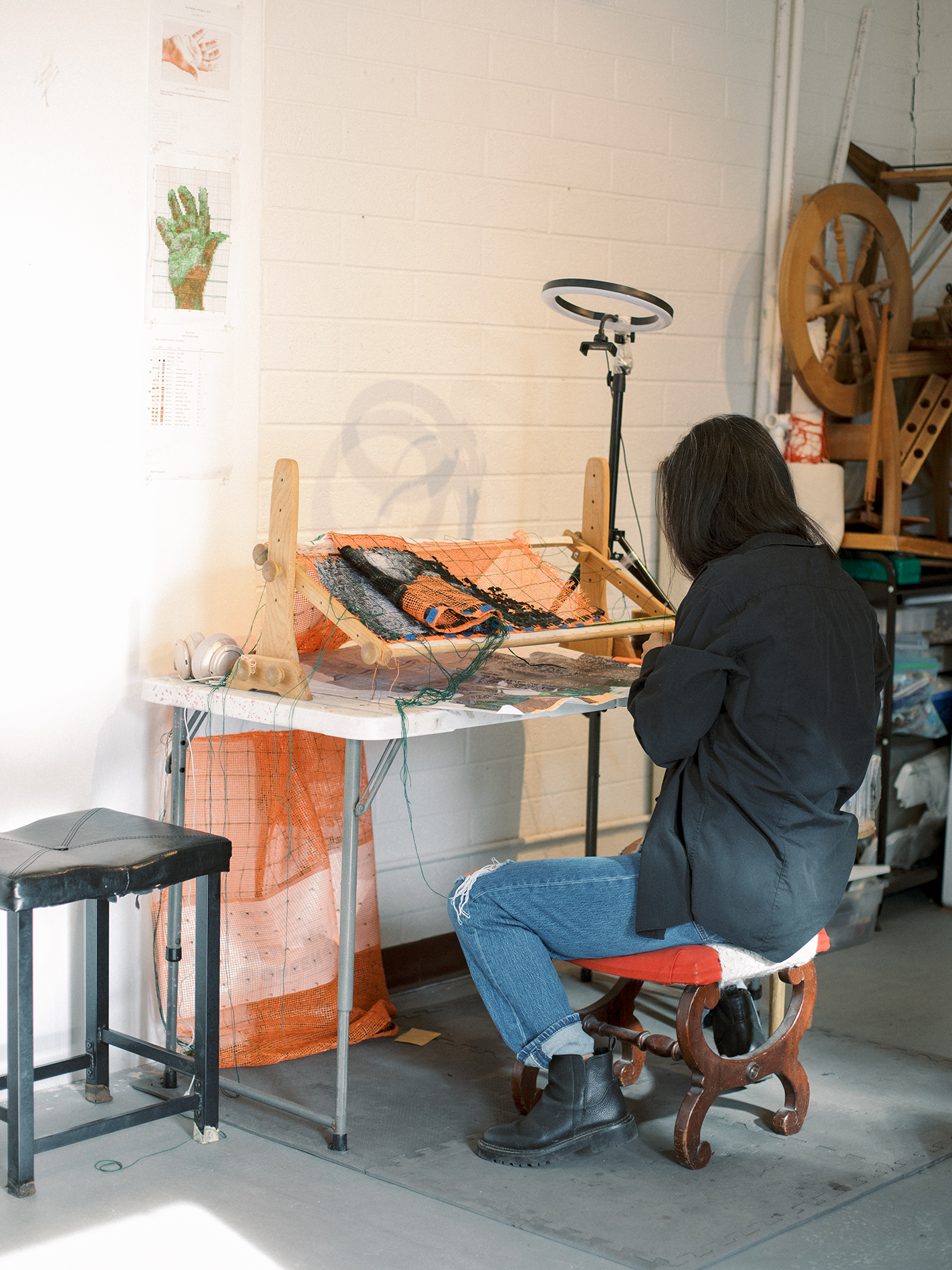
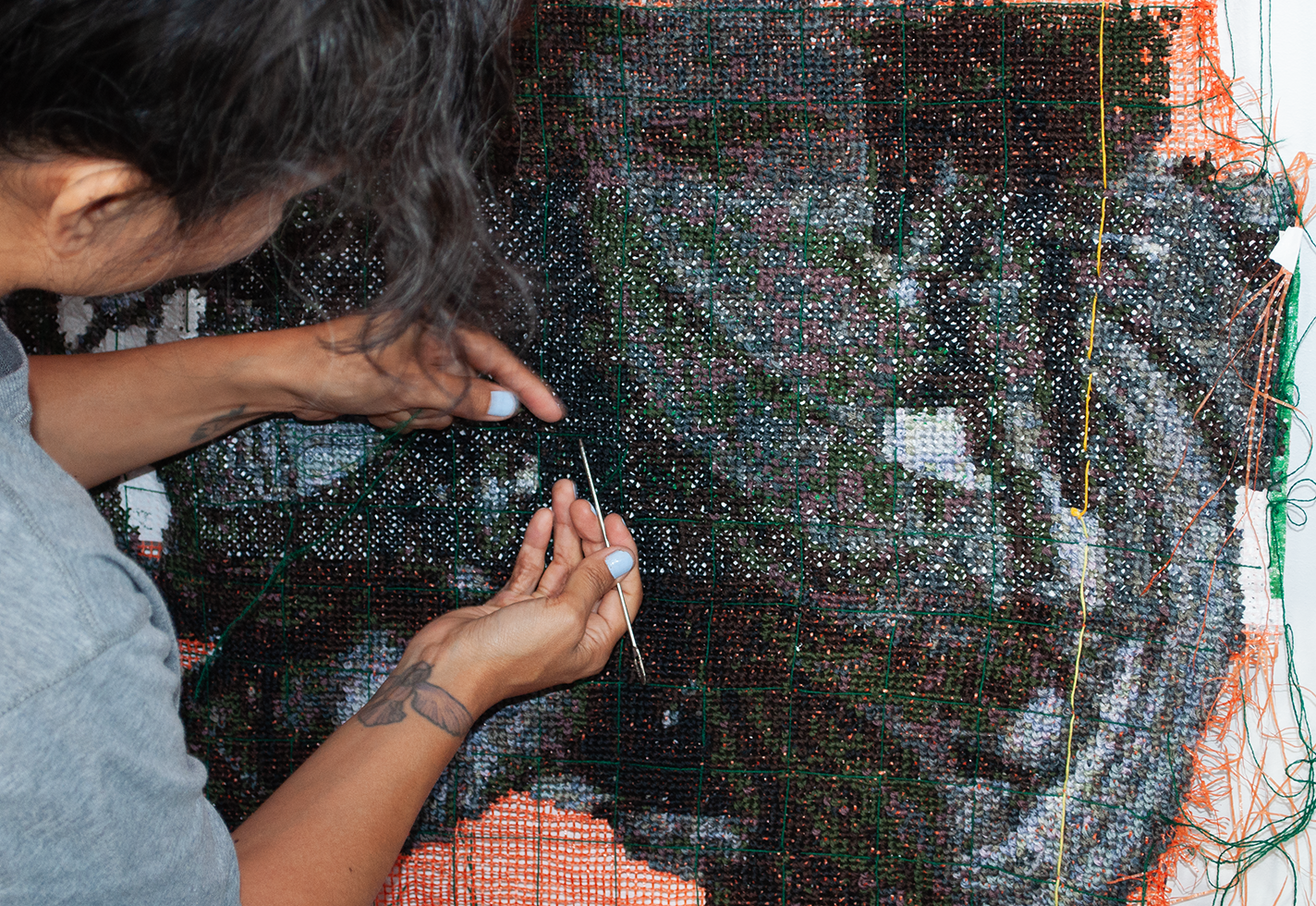
Martinez-Granados begins by converting photographs into custom gridded patterns, mapping shadows and features into coded marks. She then recreates that grid directly onto commercial mesh before stitching the image by hand. The produce bags she uses often arrive torn or frayed, marked by the wear of hurried handling. “When I was first working with the mesh,  something that stood out to me was the way the bags were discarded and the violence that happens to these materials,” she says. Sometimes, Martinez-Granados reinforces weak points or mends small tears. Other times, she leaves the damage intact, allowing the material’s previous life to remain legible within the finished work. That sensitivity to what the mesh has endured is reflected in her choice of subject. 

In Retrato de Pablo, Martinez-Granados renders bracero Pablo Ocón Franco in a delicate palette of purples, pinks, and browns, his face set against a bright yellow background that gathers around him like a halo. The portrait is part of a larger series that examines the United States’ Bracero Program, the World War II–era agreement that brought Mexican laborers to the US during agricultural shortages. Despite promises of fair wages and humane treatment, braceros endured long hours under harsh conditions, often without pay. Made from 12,321 stitches, Retrato de Pablo took Martinez-Granados months to complete and became an exercise in attention toward those whose narratives have largely been erased.
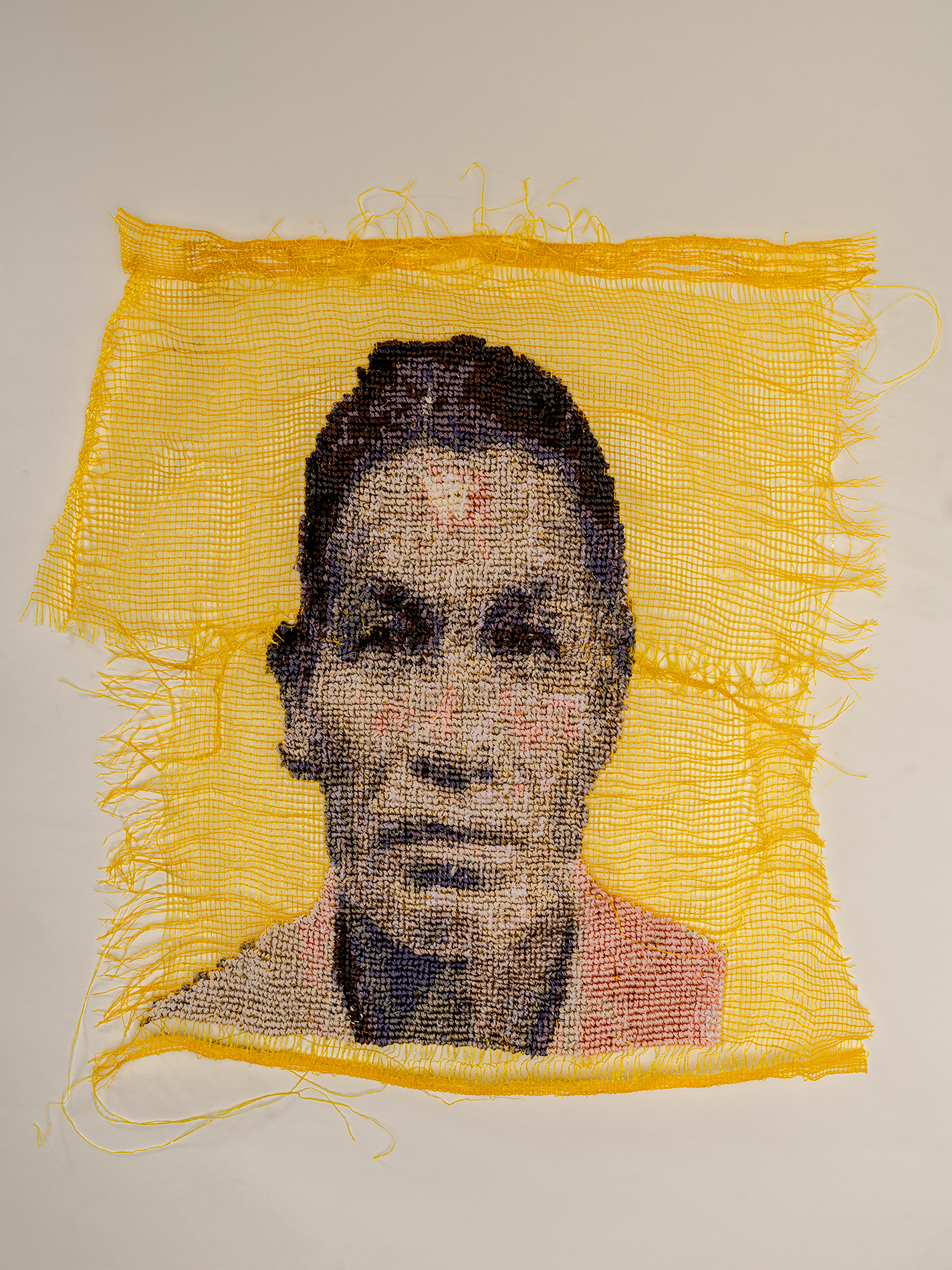
Photo by Alonso Parra, courtesy of the artist

Retrato de Pablo, 2024, cross-stitch on produce bags.

Born in Guanajuato, Mexico, Martinez-Granados moved to the United States at eight and was raised in South Phoenix, a historically agricultural corridor along the city’s southern edge. As a recipient of Deferred Action for Childhood Arrivals (DACA), she renews her status every two years, a precarity heightened by the country’s ongoing anti-immigration measures. In turning to the histories of the braceros—including her grandfather—she considers how, in immigrant families, “you’re always in survival mode,” a condition that leaves little room for reflection. This project, she suggests, and the slow, meditative process of fiber arts, creates space for something more restorative.

These concerns continue in My Mother’s Hands, a triptych stitched into red netting once used to carry onions. The piece depicts her mother’s cupped palms alongside two moringa seeds she describes as “shaped like angel’s wings.” Installed next to Retrato de Pablo, Martinez-Granados draws a line between her mother’s hands, the braceros’, and her own. Together, the two works recognize a labor bound across generations in the making of this country.

Photo by Ciara DeSpain

Martinez-Granados cross-stitching on produce bags.

Photo by Maria Nancy Thomas

Martinez-Granados working on Braceros: El Retrato de Francisco, 2025.

Jacqueline Huynh Young is a Vietnamese American artist and writer based in Los Angeles.

Learn more about Gloria Martinez-Granados online.

Website Instagram

This article was made possible with support from the Windgate Foundation.

Before you go!

We believe that making creates a meaningful world, and we hope you do, too. Deeply researched and impactful journalism on the craft community is in short supply. At the same time, being featured in craft-centered media and articles can have a major effect on a maker’s or artist’s livelihood, particularly those who are just starting in their career. You can help support our mission and the work of makers around the country by becoming a member or by making a gift today.

Thank you!
American Craft Council