Craft Around the Country

Fiber Artists Find Stories Everywhere in a New Wisconsin Exhibition

The quilted, woven, embroidered, and hooked works in Stitched Stories: Narrative Quilts and Textiles, on at the Racine Art Museum through November 21, run the gamut in tone and form.

By Jon Spayde
June 26, 2026

Photo by Rachel Comande

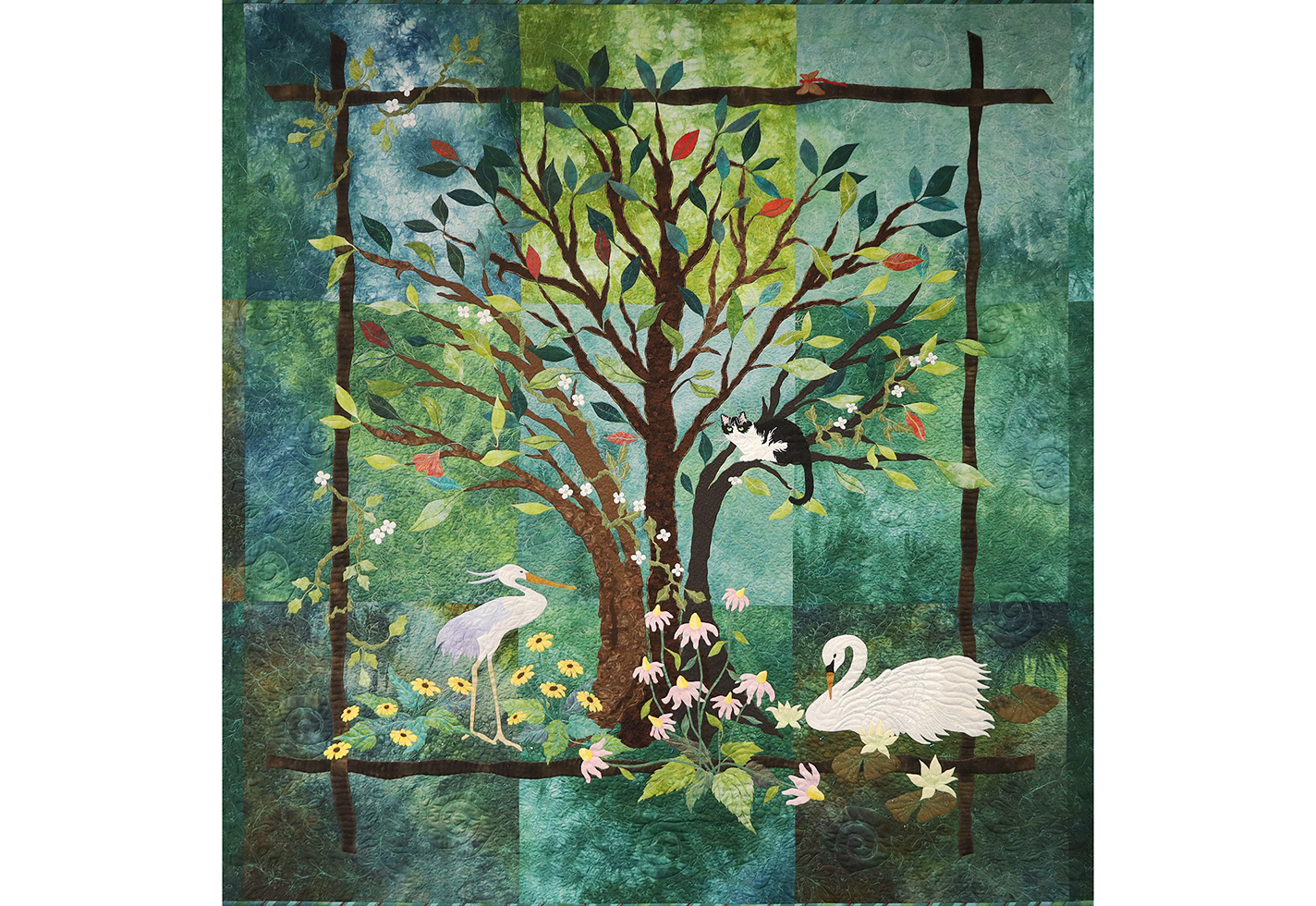
Ann Fahl, A Quilter’s Menagerie, ca. 2005, commercial fabric, hand-dyed fabric, thread, 61 x 62 in.

In a new show, the Racine Art Museum sets out to suggest just how many ways a fiber artist can tell a story.

The 25 works in Stitched Stories: Narrative Quilts and Textiles (on view through November 21), all from the museum’s collection, share a storytelling intention, but that’s about all they share. Employing quilting, weaving, embroidery, and even rug-hooking, a roster of international, national, and regional artists tell or suggest tales that are often far from straightforward, taking place in realms ranging from the very down-to-earth to the remote and fantastical—including the dreaming mind, the bottom of the sea, and outer space. 

“There are a number of responses you can have to Stitched Stories,” says Katelyn Mitchell, the museum’s associate curator. “At one level, storytelling is universal, and the figurative is a very straightforward way to tell a story. Some of the pieces incorporate text, which is another familiar way to convey meaning. Hopefully by seeing those approaches in context with other approaches, like decoration and abstraction, visitors can be led to think about stories in a very different way.”

A case in point is Braided River, a 2012 quilted wall hanging by Madison, Wisconsin–based Leah Evans. A narrow, winding, branching black shape makes its way across its surface—the map of a river, no doubt, but without the specificity of a map, it’s nearly abstract. The “land” it traverses is itself crisscrossed by thousands and thousands of hair-thin squiggles that suggest the mind-blowing complexity of the natural world—and, perhaps, of the stories we could tell about it.
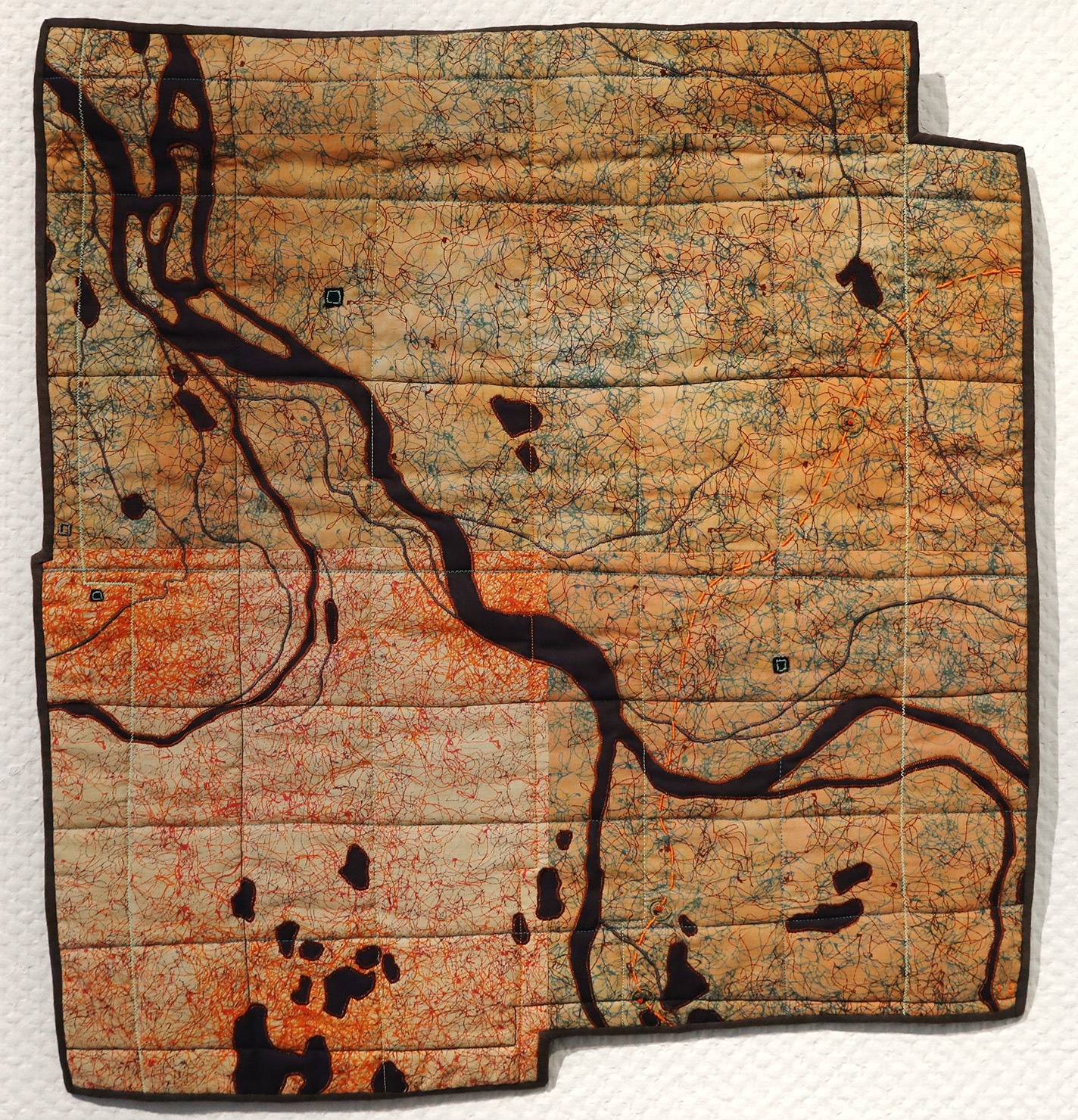
Photo by Rachel Comande

Leah Evans, Braided River, 2012, dyed cotton fabric, thread, 22 x 20 in.

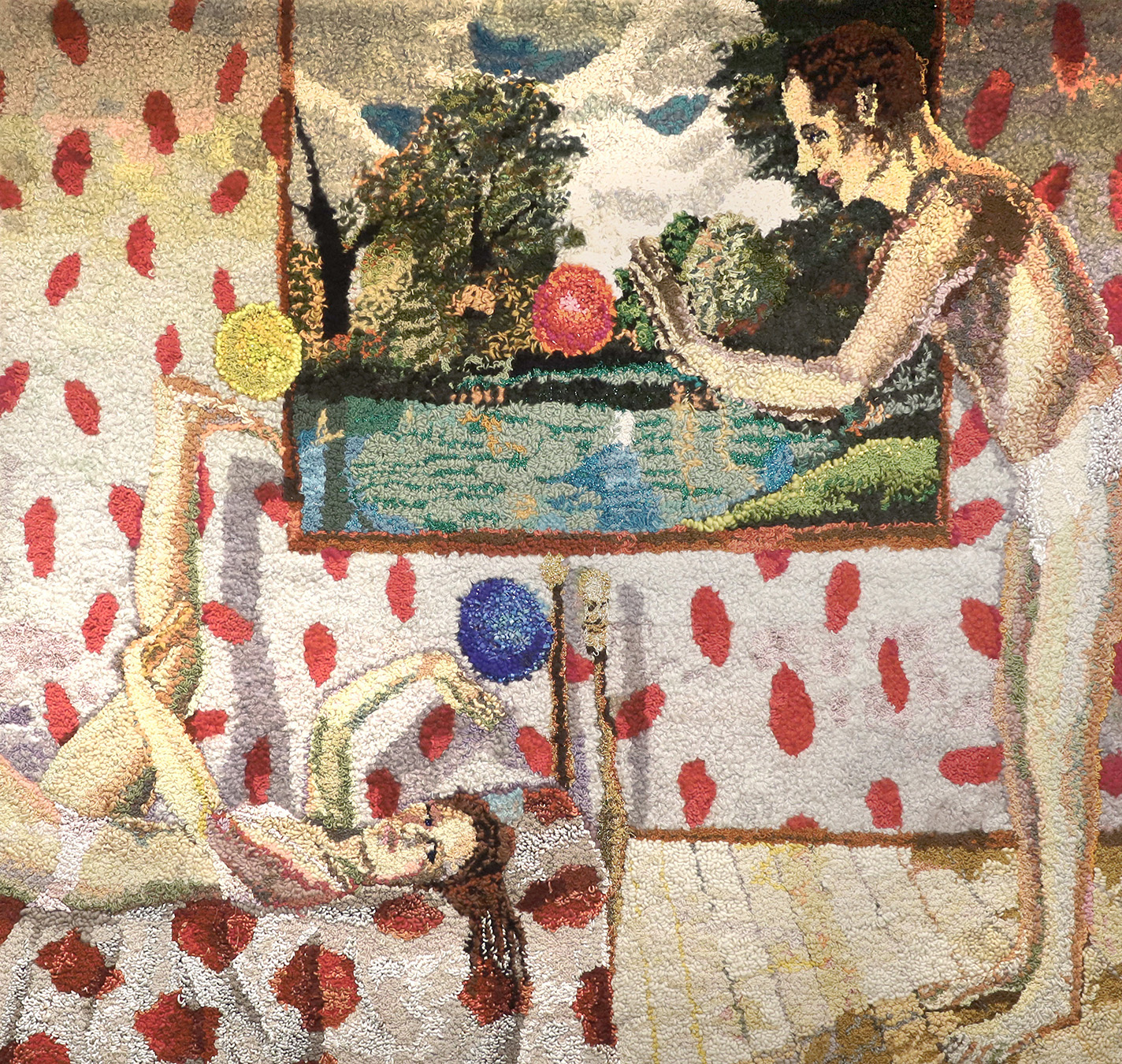
For Mitchell, Bouncing Ball, a 1979 hooked rug by Shari Urquhart, “sets the stage for the whole exhibition.” The hanging depicts an enigmatic encounter between a supine woman and a standing man, both near life-size. The pair are batting three balls—in yellow, blue, and red—back and forth in front of a window that opens on an idyllic nature scene. It doesn’t so much tell a story as invite the viewer to supply his or her own narrative of romance, dominance, submission, relationship, play, and power. 

Widely exhibited, Urquhart was born in nearby Kenosha, Wisconsin, and returned from New York to the Badger State in her final years. “Bouncing Ball is a very exciting piece to show in this exhibition because she has such a national reputation, but she’s also a real member of our community,” says Mitchell.

Wisconsin makers are featured prominently in the exhibition, but its curator cast a wider net as well. Tokyo-born New York artist Ai Kijima is represented by Groovy Valentine, a wacky pop-art reflection on contemporary storytelling done in found fabric and dyed cotton thread. Against a sky filled with floppy little hearts, the main Star Wars characters advance upon the viewer, and so does a smiling, incredibly bulked-up, bald pro wrestler. Ducks migrate over the characters’ heads, and down in the left-hand corner a helicopter with a cute face and the name “Harold” on its fuselage flies over a palm-tree dotted tropical landscape.

Oh, the stories!

Photo by Rachel Comande

Shari Urquhart, Bouncing Balls, 1979, wool, mohair, metallic and silk fibers, yarn, plastic, 72 x 80 x 1 in.

Jon Spayde is a writer and editor in Saint Paul, Minnesota. A former contributing editor to American Craft, he writes on art, psychology, education, and personal growth for a number of regional and national publications.

Learn more about Stitching Stories online.

Website

Before you go!

We believe that making creates a meaningful world, and we hope you do, too. Deeply researched and impactful journalism on the craft community is in short supply. At the same time, being featured in craft-centered media and articles can have a major effect on a maker’s or artist’s livelihood, particularly those who are just starting in their career. You can help support our mission and the work of makers around the country by becoming a member or by making a gift today.

Thank you!
American Craft Council