Craft Around the Country

Maryam Yousif’s Objects for the Living

The Iraqi American artist draws on family history and ancient tombs for her works in clay.

By Jacqueline Huynh Young
June 1, 2026

Works by Maryam Yousif in her exhibition Above Earth, Under The Rays of the Sun at The Pit in Los Angeles. From left to right: Standing Pazzuzu, Pomegranate Bottle in Interstellar, and Green Harp Player Figure.

San Francisco-based ceramist Maryam Yousif is interested in the things people carry with them when they leave a homeland behind. In her family’s case, that means her grandmother’s earrings, a matching set of rings worn by her mother and aunt, and a handful of other keepsakes considered important enough to pack. 

These objects form the emotional core of Above Earth, Under the Rays of the Sun, Yousif’s exhibition at The Pit in Los Angeles, on view through June 17. The show takes inspiration from the Queen’s Tombs at Nimrud (ca. 9th-8th century BCE), an archaeological site in what is now northern Iraq, where Assyrian queens were buried alongside more than 700 pieces of gold, jewelry, pottery, and ceremonial objects intended to accompany them into the next life. “I really love tomb findings,” she says. “Especially when they’re connected to women who at one point had some sort of status and power.”

The exhibition itself takes the shape of a tomb, with ceramic birds, pomegranates, palm trees, harp players, crowns, and female figures arranged throughout the gallery like funerary offerings. At its center sits a monumental head modeled after the Neo-Assyrian ivory bust known as Head of a Female Figure (ca. 8th–7th century BCE). Yousif remade it in clay, adding a pair of gold earrings fashioned after those passed down from her grandmother. “I wear them all the time,” she says. “They’ve become part of my body and my story.”

Photo by Chris Gunder

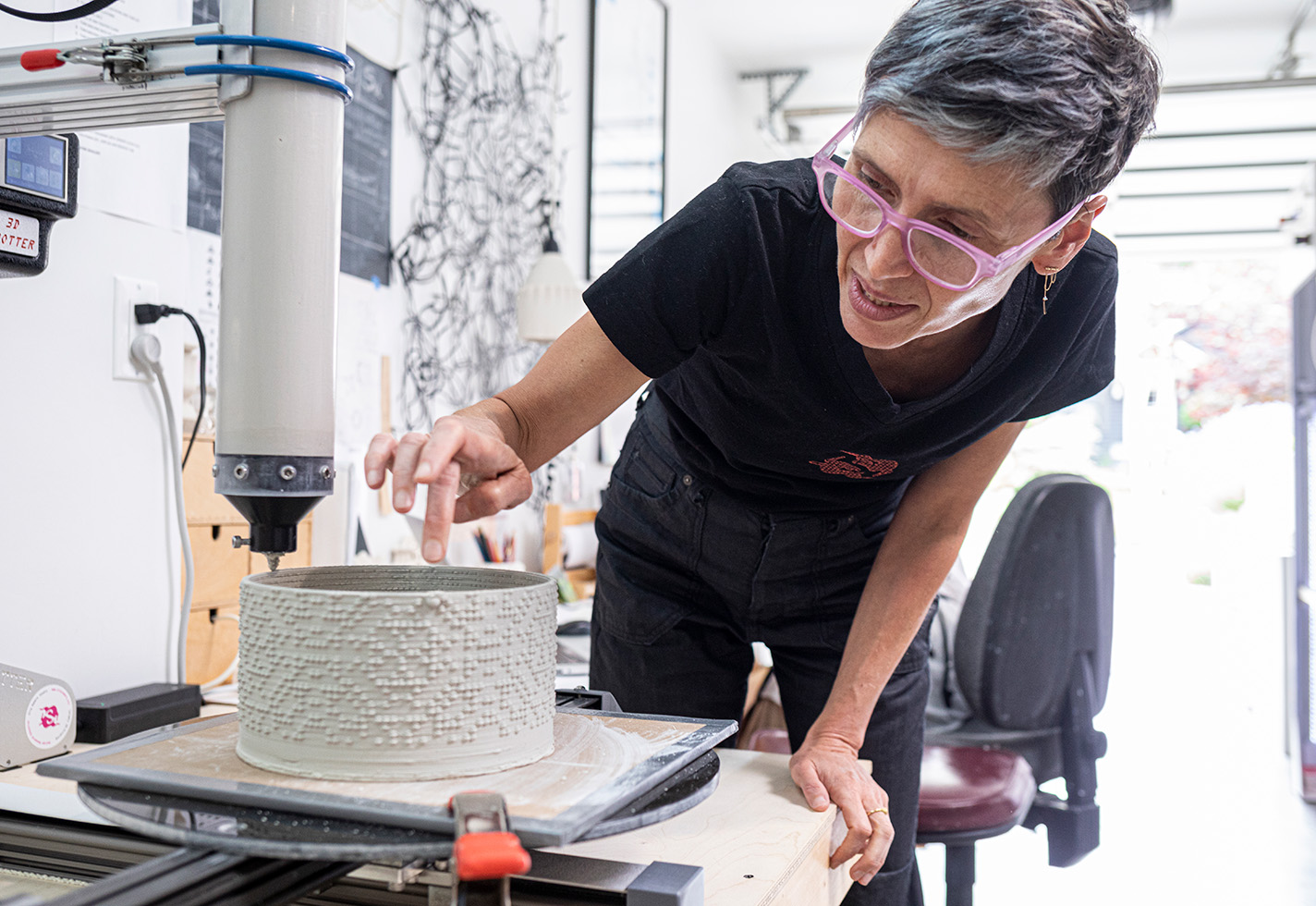
Maryam Yousif in her studio.
During the Iran–Iraq War in the 1980s, her grandfather was deported from Iraq because of his distant Iranian ancestry. “My grandma fought really hard to bring him back,” she says. “He left with not much and returned with these beautiful earrings for her.” Yousif named her sculpture Head of a Female Figure with Deportation Earrings.

Carved into the back of her sculpture’s crown is a mirrored image of the Iraqi marshes, an ode to her mother, an artist who has painted variations of the landscape for as long as Yousif can remember. “Every time I call her, there’s a new painting behind her with the boats and the marshes,” she says. 

Depictions of these marshes became part of Yousif’s understanding of Iraq long before she ever saw them for herself. A UNESCO World Heritage site, the Mesopotamian Marshes are in southern Iraq, a region commonly described as “the cradle of civilization.” The marshes feature prominently in Iraqi art. “If you’re Iraqi, those images are so familiar to you.” They have become, she says, “baked into my retina.”

Photo by Chris Hanke

Head of Female Figure with Deportation Earrings, 2026, glazed ceramic, 23 x 25.5 x 15 in.

  • Photo by Chris Hanke

    Habibti in Yellow Desert Rosette Dress, 2026, glazed ceramic, 18 x 12 x 12 in.

  • Photo by Chris Hanke

    Habibti in Green Rosette Dress, 2026, glazed ceramic, 14 x 11 x 10 in.

  • Photo by Chris Hanke

    Habibti in Tangerine Rosette Dress, 2026, glazed ceramic, 14 x 10.5 x 9.5 in.

Flanking the central sculpture are two 33-inch-tall ceramic palm trees titled Palm Tree with Hassoon’s Pattern. The dotted grid decorating the trunks comes from a ninth-century oil lamp Yousif came across during her research. The lamp’s maker had signed the piece “Hassoon,” so when Yousif borrowed the pattern, she named the sculptures after him.

Such research forms a large part of Yousif’s artistic practice. Around the time she graduated from San Francisco Art Institute, she visited the British Museum and saw Mesopotamian artifacts in person for the first time. “I was just so taken by the craftsmanship,” she says. “I hadn’t seen them before, and I was in awe that they were connected to a place I’d come from.”

While researching the Nimrud tombs, she became fixated on a cuneiform text warning future intruders against disturbing the queens and their belongings. The title of her exhibition at The Pit comes from that text. “The translation is incredible. Whoever comes into this tomb and removes me or my jewelry with evil intent, above earth, under the rays of the sun, let their spirit roam outside and thirst below in the underworld,” Yousif says, paraphrasing the full quotation. 

The sentiment lodged itself into her thinking. Though the pieces in the exhibition reference funerary objects, Yousif is less interested in death than in what the objects reveal about the living. The line, she explains, is locational: above the earth (where the queens are buried) and under the sun. “It’s where the living roam,” she says.

Photo by Chris Hanke

Palm Tree with Hassoon's Pattern, 2026, glazed ceramic, 33 x 19 x 19 in.

Three of her signature “habibti” figures—an Arabic term of endearment meaning “my love” or “sweetheart”—appear throughout the exhibition. Clad in yellow, orange, and green rosettes pulled from the ornamental details found on the crown of Head of a Female Figure, the sculptures are based on ancient Sumerian votive figurines once placed in temples on behalf of worshippers during the Early Dynastic period of Mesopotamia (ca. 2900-2350 century BCE). Since only priests could enter certain sacred spaces, people commissioned figures of themselves to stand in their place. 

Archaeologists study skeletons and objects to reconstruct histories. “You don’t know them,” she says of the queens buried at Nimrud, “but because of what remains, you’re piecing together a picture.” In Above Earth, Under the Rays of the Sun, Yousif does the same with her own history, assembling a tomb filled with evidence of a life carried forward. “My family left their homeland, maybe forever, and the things that they packed in their suitcases were really special,” she says. “We don’t have much from Iraq, and so the few things we do have connect us to that place.” 

Looking over photographs of the tombs on her computer, Yousif asks, “What do you send with people into the next life?”

Photo by Chris Hanke

Catalogue Scroll, 2026, glazed ceramic, 19 x 20 x 5 in.

Jacqueline Huynh Young is a Vietnamese American artist and writer based in Los Angeles.

Learn more about Maryam Yousif and The Pit online.

Maryam Yousif The Pit

This article was made possible with support from the Windgate Foundation.

Before you go!

We believe that making creates a meaningful world, and we hope you do, too. Deeply researched and impactful journalism on the craft community is in short supply. At the same time, being featured in craft-centered media and articles can have a major effect on a maker’s or artist’s livelihood, particularly those who are just starting in their career. You can help support our mission and the work of makers around the country by becoming a member or by making a gift today.

Thank you!
American Craft Council