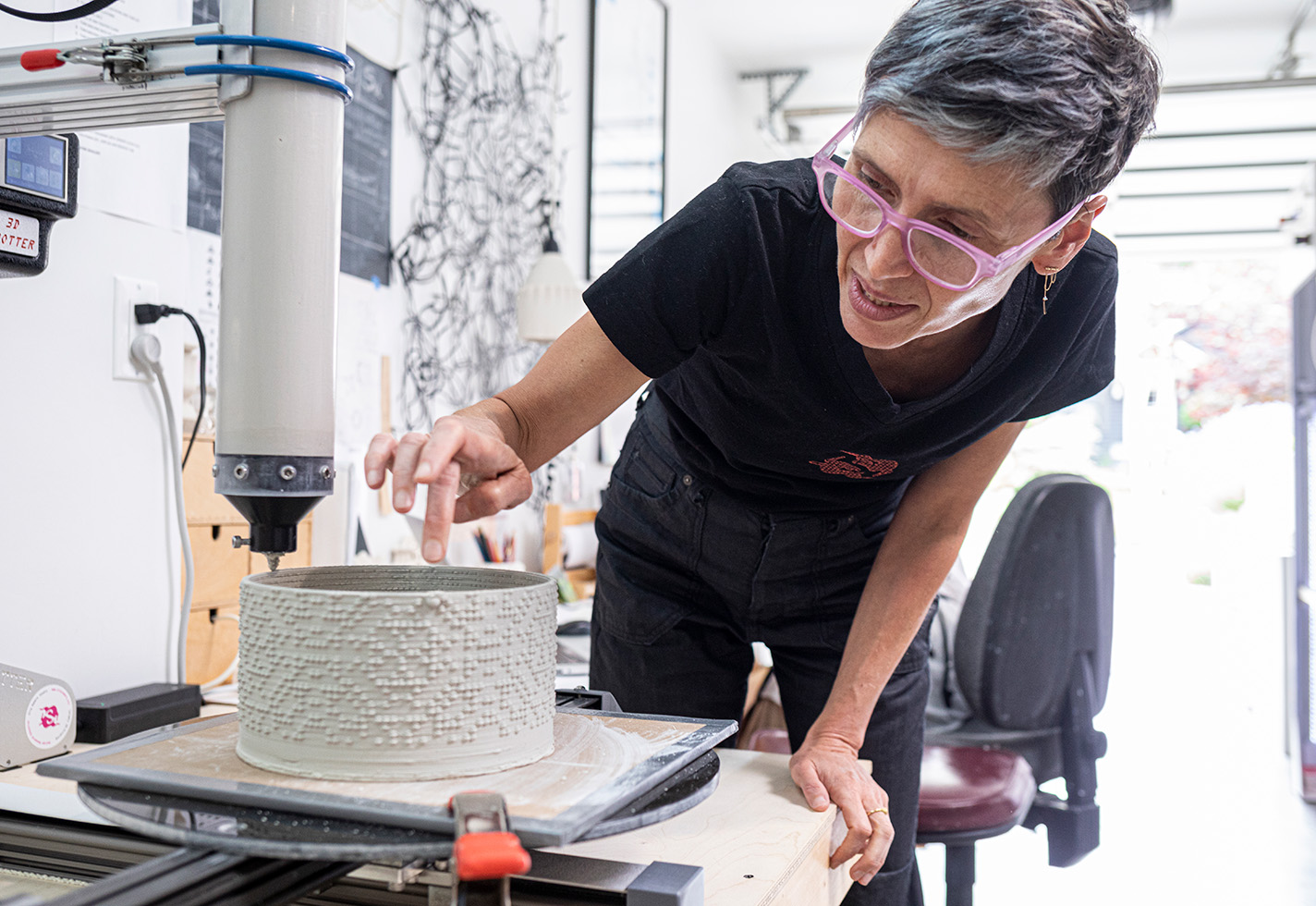
In her studio in southeastern Idaho, Diane Myers pulls loops of roving through a heavily starched mesh to make a pulled wool saddle pad (PWSP). It’s a long process that can take anywhere from 10 to 40 hours, depending on complexity. “My work area is typically a mess,” Myers admits with a laugh, noting that wool fibers tend to travel everywhere. “But with a good vacuum, it’s manageable.”
The resulting saddle pads—thick, handmade cushions placed between a horse’s back and the saddle to protect the horse during riding by distributing weight, reducing friction, managing heat, and wicking away moisture—are prized by riders for their comfort, durability, and personalization.
There is a big difference between a handmade pulled wool saddle pad and a commercial, factory-made pad. Mass-produced pads are made from recycled wool or heat-treated fibers and are often dense, compressed, and inflexible. Myers’s pulled-loop design is soft, flexible, and responsive, conforming to the horse’s back like a worn-in sock. The wool loops allow air to circulate, regulate temperature, wick away moisture, and help the horse sweat evenly—reducing muscle tension and increasing comfort.

A custom-ordered pad with three-dimensional red roses.