Craft Around the Country

Jen Bervin's Quilts Wrestle with the Shifting Meaning of Emily Dickinson's Poems

The Connecticut artist has been chipping away at her 30-quilt series The Dickinson Composites for over two decades—and hopes to finish by 2030.

By Kate Schuler
October 30, 2026

Photo by Zo Reynolds

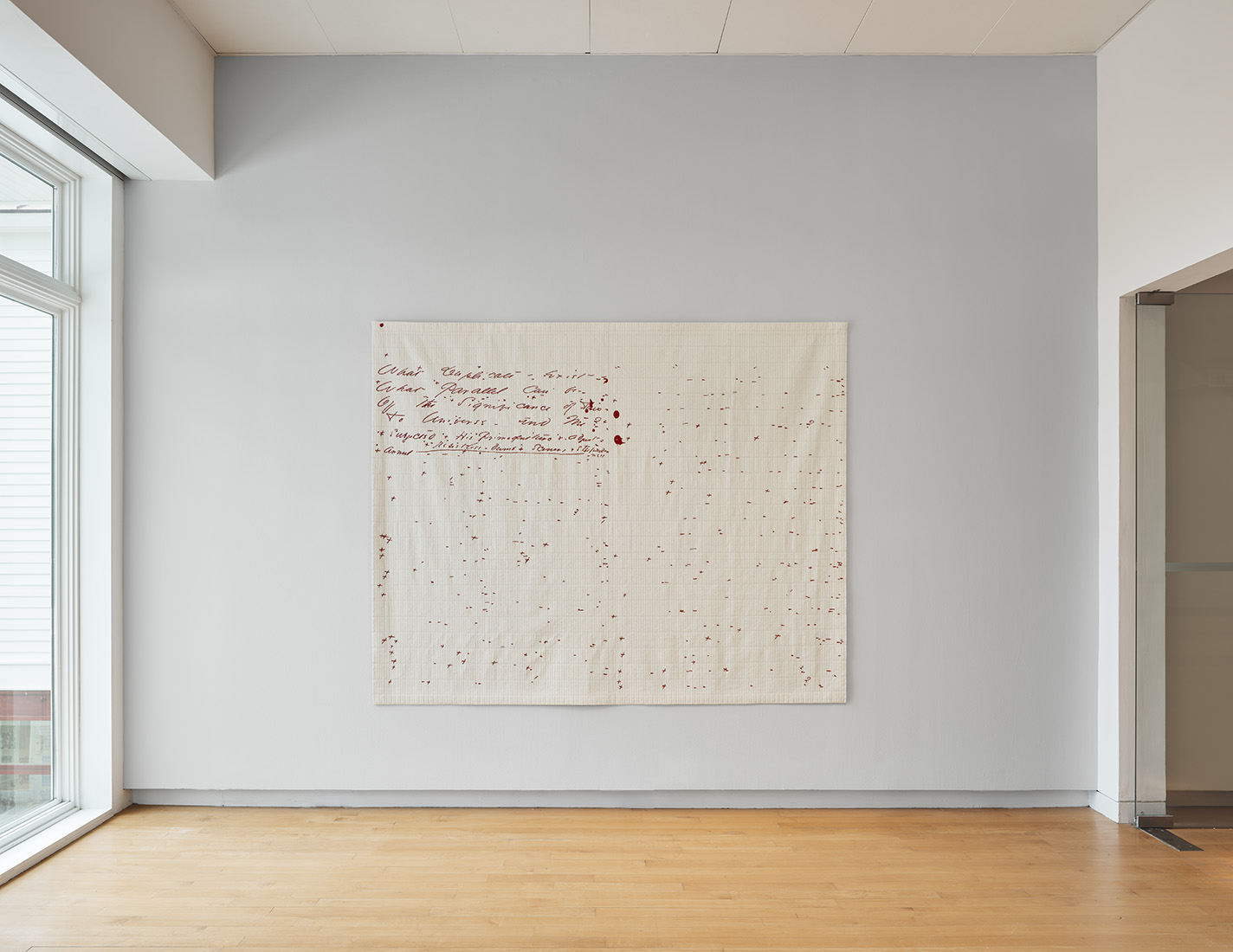
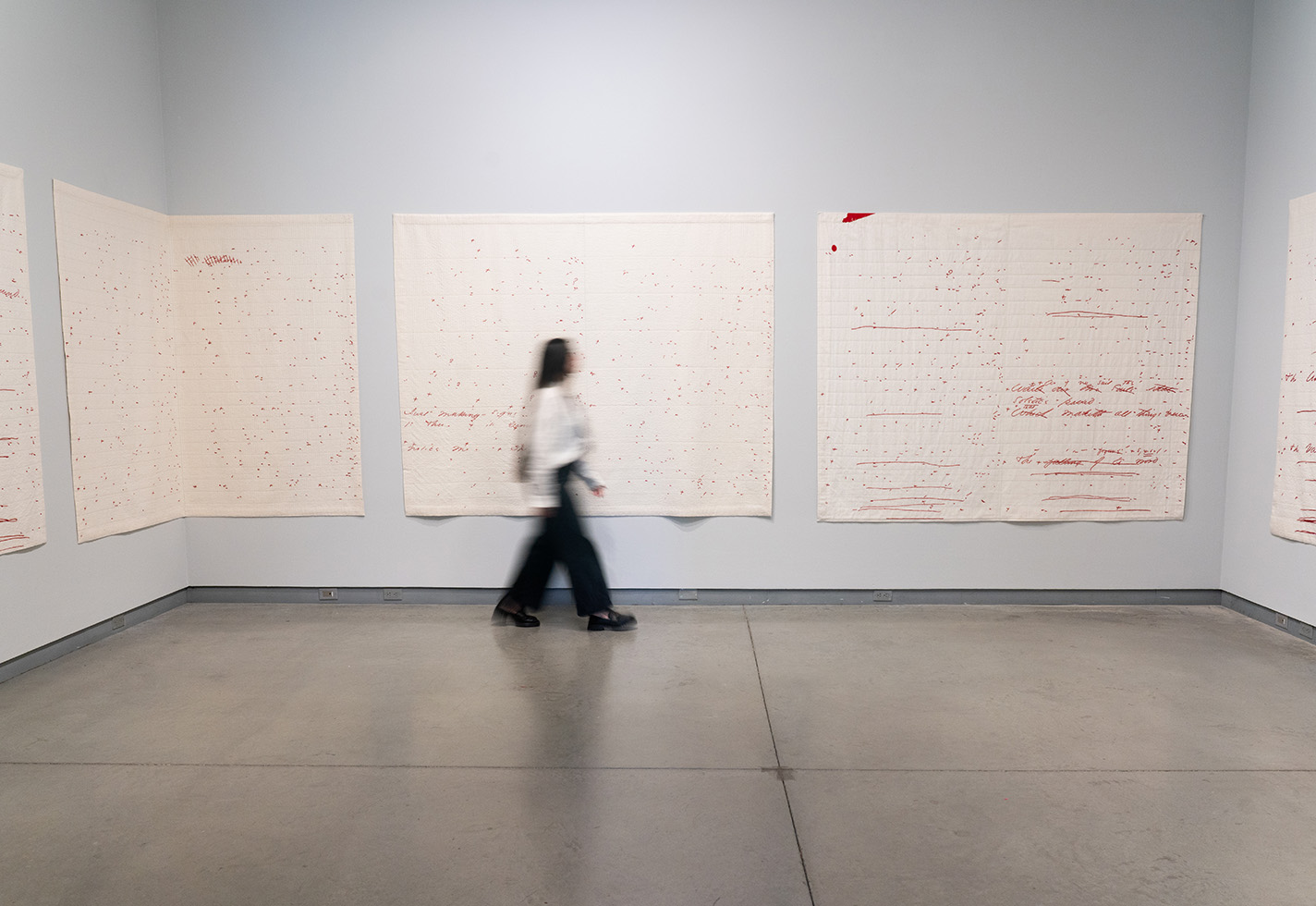
Quilts from Jen Bervin's ongoing series The Dickinson Composites installed as a part of the survey Shift Rotate Reflect at University Galleries of Illinois State University, 2025.

Emily Dickinson largely avoided publishing during her lifetime, but she left behind nearly 1,800 handwritten poems when she died in 1886. In a singular, elliptical style marked by compact language and extensive use of dashes, she explored themes of nature, grief, religion, and art.  

During the most active period of her career, from 1858 to 1864, she copied more than 800 of her poems onto folded sheets of stationery, stacked them into 40 packets (later called “fascicles” by her editors), numbered them chronologically, and stitched them together with a single thread. By Fascicle 11, Dickinson began to place small plus signs in the lines of a poem, keyed like a footnote to lists of alternative word choices she wrote in the margins of a page. The symbols are often faint and the words occasionally underlined or crossed out in Dickinson’s expressive hand. 

“As drawings, they’re extraordinary. As poems, they’re extraordinary,” says multidisciplinary artist and poet Jen Bervin, who has made them the focus of her current textile work. One of Bervin’s quilts wrestling with these formalistically thorny poems is now on view at the Aldrich Contemporary Art Museum in Ridgefield, Connecticut through January 10 as part of the non-collecting museum’s first decennial.

While early editors dismissed Dickinson’s “variants” as indecision and omitted the notations during publication, Bervin stands with the scholars (like her frequent collaborator, the English professor and Dickinson expert Marta Werner) who read the poet’s markings as a deliberate choice to embrace multiple meanings. “She made up her mind to not make up her mind,” says Bervin. “To unmake that choice when you print the poems seems to me a violence that should not happen.”
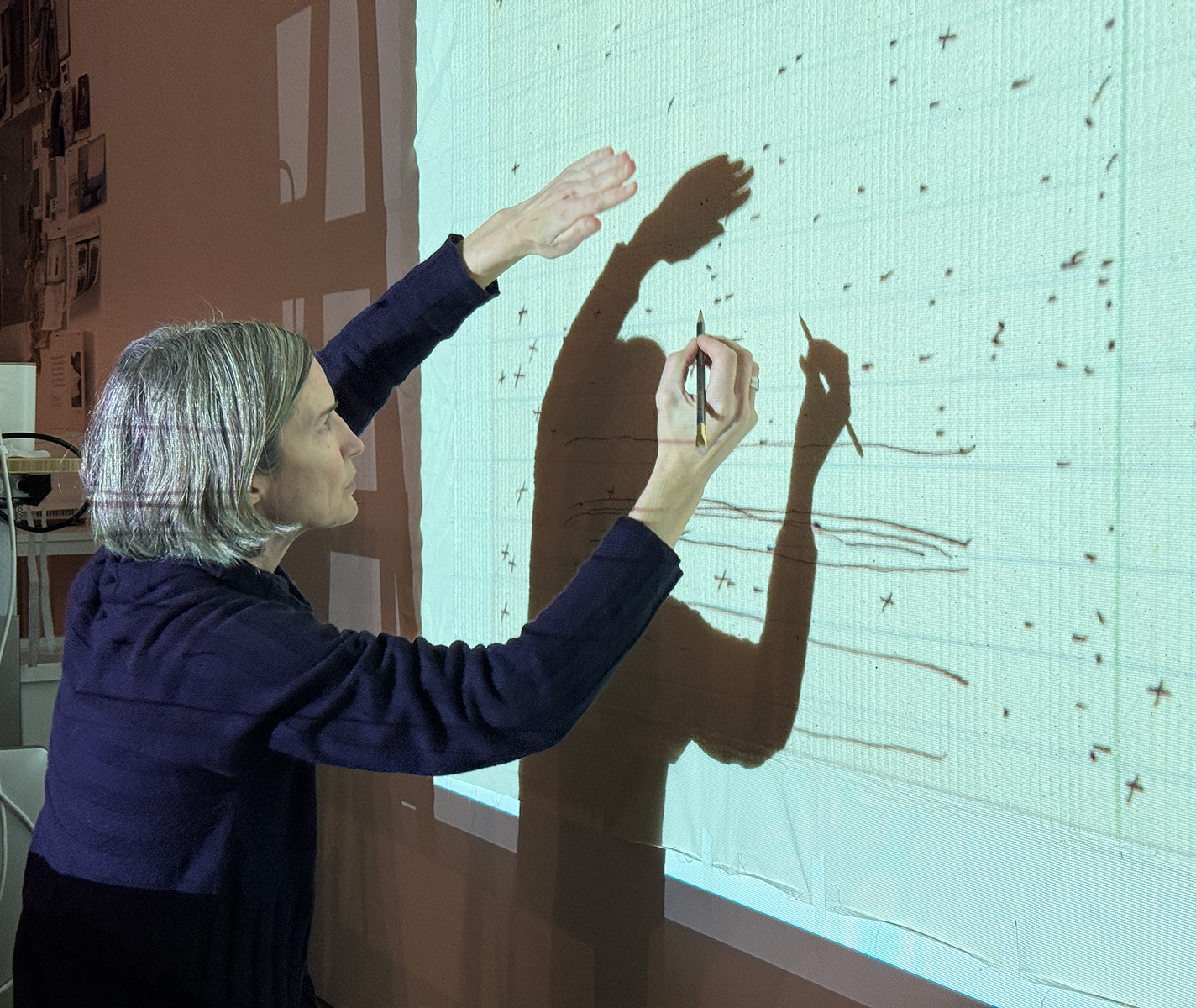
Photo by Charlotte Lagarde

Bervin working in her Connecticut studio.

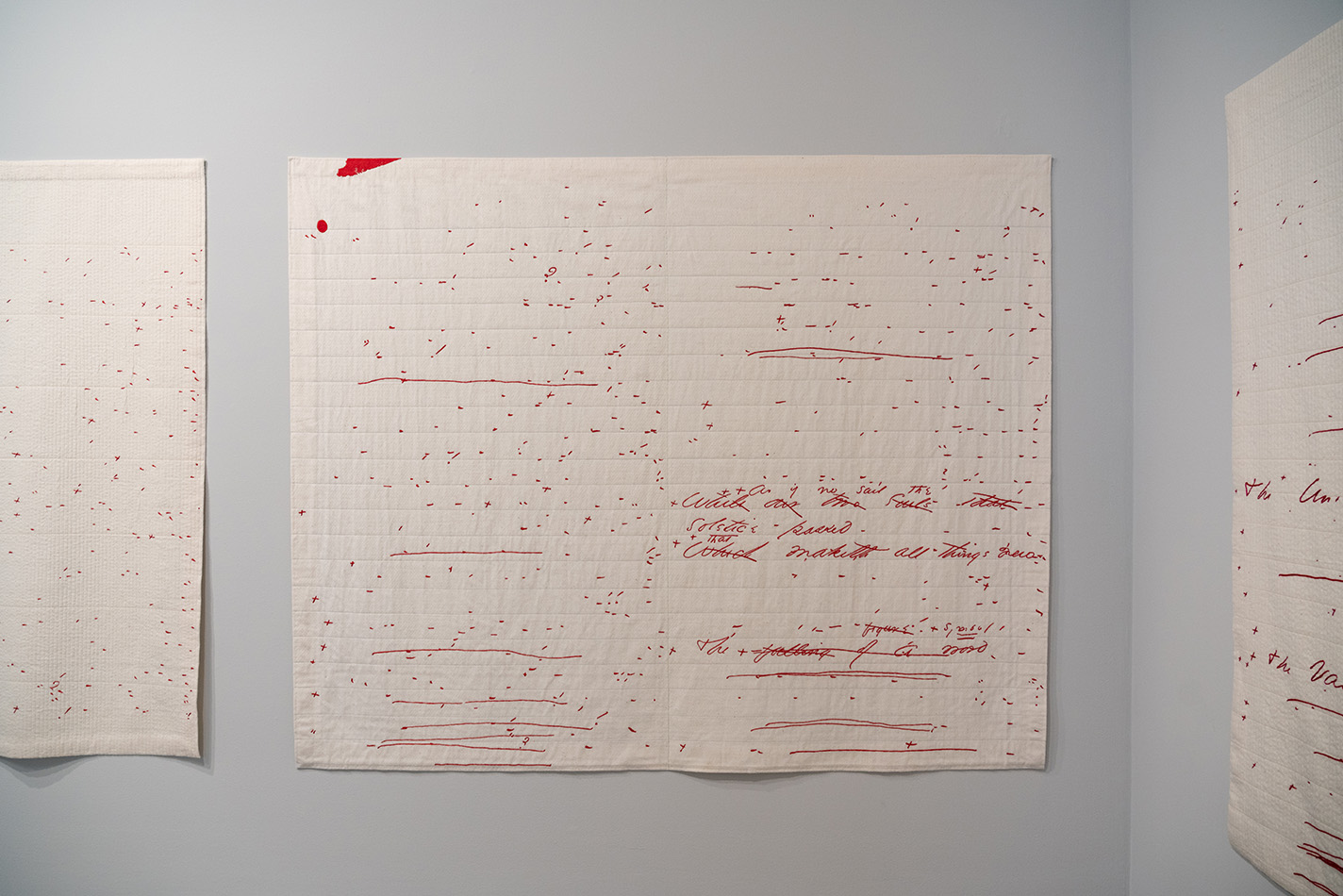
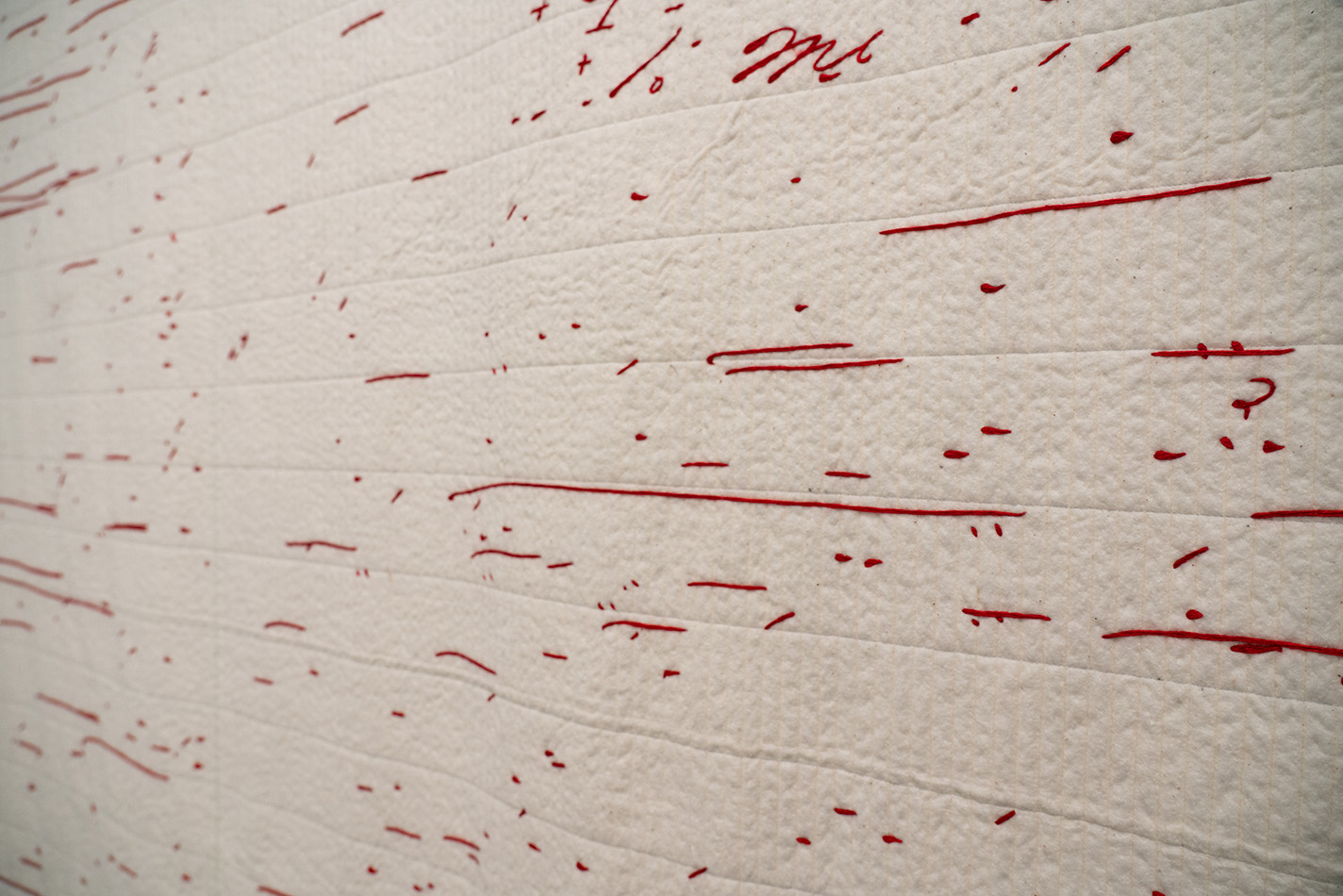
Out of that conviction grew Bervin’s monumental project The Dickinson Composites, an effort to map Dickinson’s “variant markings” across 30 large-scale embroidered quilts. Measuring six feet by eight feet, each quilt in the series uses muslin-backed cotton batting and quilted rule lines to evoke the poet’s 19th-century stationery. Bervin embroiders Dickinson’s variant symbols in hand-dyed red silk thread across each piece. “I wanted it to be a bright reinstatement of the marks, but also to gesture towards the violence of their removal,” she says.  

Bervin came to Dickinson’s work first with the eye of a visual artist and then as a poet. Trained in fibers and sculpture as an undergrad at the School of the Art Institute of Chicago, she first encountered Dickinson’s handwritten pages while pursuing a master’s degree in creative writing at the University of Denver. “The marks are hard to see, even when you’re looking for them,” says Bervin. “I love things that disappear in plain sight and that kind of call you out on your ‘not-lookingness.’”

To design each quilt, she scans images of the fascicle pages and layers them to create digital composites plotting the coordinates of the marks. Projecting the image lets her trace the pattern by hand onto the fabric. The embroidery varies in density from quilt to quilt as Bervin plays with composition, letting some of Dickinson’s words surface from the field of marks. 

The scale of the marks themselves shifts across the original fascicles. In The Composite Marks of Fascicle 16, the crosses are large and bold, while the markings in The Composite Marks of Fascicle 40 are small but numerous. Bervin says she started by looking at the scale of the mark as a sort of “planar shift,” where the words and symbols become pulled apart and spacious. The red stitches skip across the cotton ground, gestural and dynamic, almost like gashes.

Photo by Olympia Shannon

Bervin's work installed as a part of The Aldrich Decennial: I am what is around me at the Aldrich Contemporary Art Museum in Ridgefield, Connecticut, 2026.

A cross-disciplinary curiosity defines Bervin’s wider practice, which frequently explores the connections between text and textiles. Her major research-led works include Silk Poems (2016), in which she collaborated with Tufts University bioengineers to reproduce a poem with the letters suspended in a nanoscale patch of liquified silk, and River, a monumental 230-foot textile installation made from silver foil-stamped sequins.

Bervin works out of a studio in Guilford, Connecticut, built by her wife Charlotte Lagarde, a filmmaker (the couple first connected over a shared interest in Black Mountain College). Designed by architect Jonah Stanford, the space is big enough to work with large-scale pieces and features large sliding panels that serve as pinboards for her research. 

Five quilts in The Dickinson Composites series were made between 2004 and 2008, and Bervin returned to the project in 2022. With a goal of completing the ambitious series over the next three to four years, Bervin plans to exhibit all 30 quilts together for the first time in 2030, the 200th anniversary of Dickinson’s birth.  

It’s a big task, but quilts can reach people on a personal level in a way Bervin finds important.  

“I love how immediately, and with a sort of intimacy, people can connect to textiles,” Bervin says. “Even something that seems pretty remote, like a work based on a literary manuscript, people still want to touch it. They still relate to the sewing.”

Photo by John Janca

Installation view from Jen Bervin: Source, a 2023 exhibition at Catharine Clark Gallery in San Francisco.

  • Photos by Jade Nguyen

    Bervin's work with The Dickinson Composites aims to capture the cryptic symbols in Emily Dickinson's poems that indicate alternative word choices.

Kate Schuler is a writer, editor, and potter based in Washington, DC.

Check out more of Jen Bervin's work online.

Website Instagram

Before you go!

We believe that making creates a meaningful world, and we hope you do, too. Deeply researched and impactful journalism on the craft community is in short supply. At the same time, being featured in craft-centered media and articles can have a major effect on a maker’s or artist’s livelihood, particularly those who are just starting in their career. You can help support our mission and the work of makers around the country by becoming a member or by making a gift today.

Thank you!
American Craft Council