Craft Around the Country

At the Museum of Contemporary Native Arts in Santa Fe, Indigenous Artists Rewrite the Record

The New Mexico museum hosts a show of works that complicate the legacy of paper in Indigenous history.

By Jacqueline Huynh Young
April 30, 2026

Photo courtesy of IAIA Museum of Contemporary Native Arts

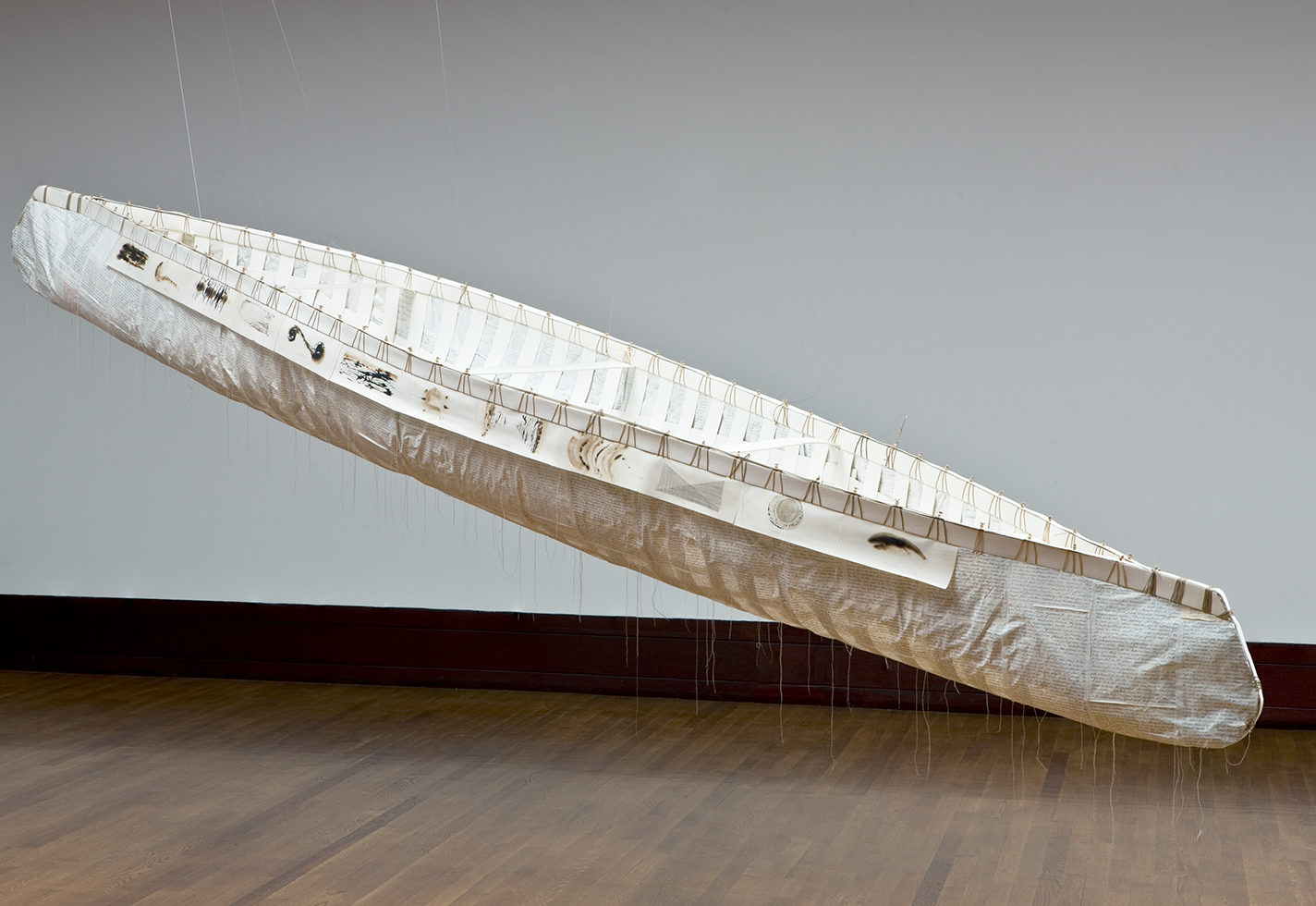
Bonnie Devine (Serpent River First Nation, Anishinaabe, Ojibwa), Canoe, 2003, graphite on paper, thread, twine, beads, 24 x 36 x 180 in.

At the IAIA Museum of Contemporary Native Arts (MoCNA) in Santa Fe, a funerary basket woven from X-ray film and translucent vellum glows from within, revealing an image of human bones. Shan Goshorn’s (Eastern Band Cherokee) Right to Remain(s) (2013) draws on Cherokee basketry traditions while incorporating handwritten reflections on belonging and displacement. 

The basket anchors Paper Trails: Unfolding Indigenous Narratives, an exhibition that examines paper as a colonial instrument of control, on view through July 12. “We’re looking at the significance of paper in hidden histories. Broken treaties, maps, and censuses come to mind,” says MoCNA Chief Curator Dr. Manuela Well-Off Man.

Across the exhibition, 23 artists complicate paper’s role as a surface for recordkeeping. Some of the artists build with the paper, while others turn to photography, tax ledgers, and cartography to disrupt how these documents are understood.
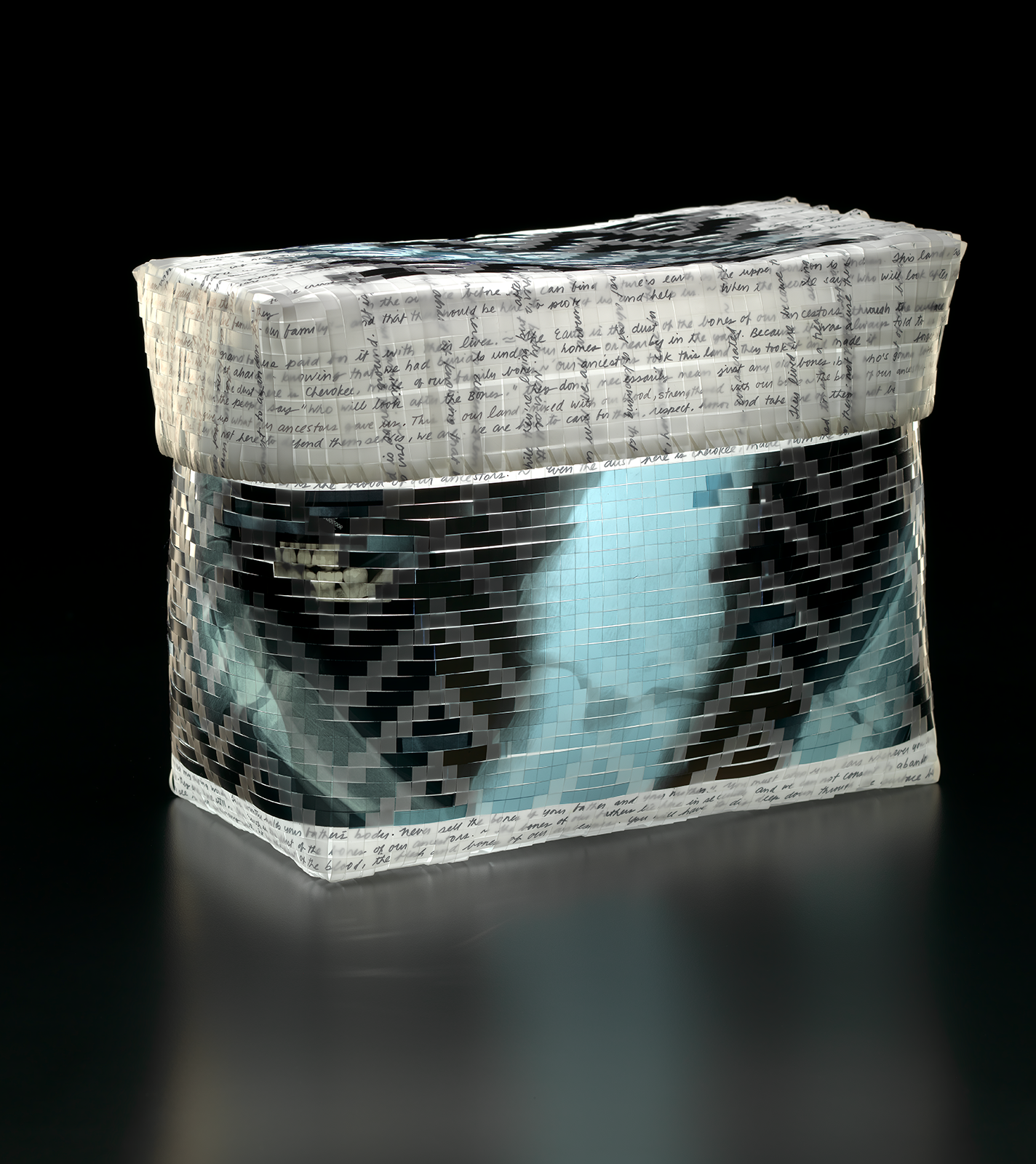
Photo courtesy of IAIA Museum of Contemporary Native Arts

Shan Goshorn (Eastern Band of Cherokee), Right to Remain(s), 2013 X-ray film, vellum, ink, graphite.

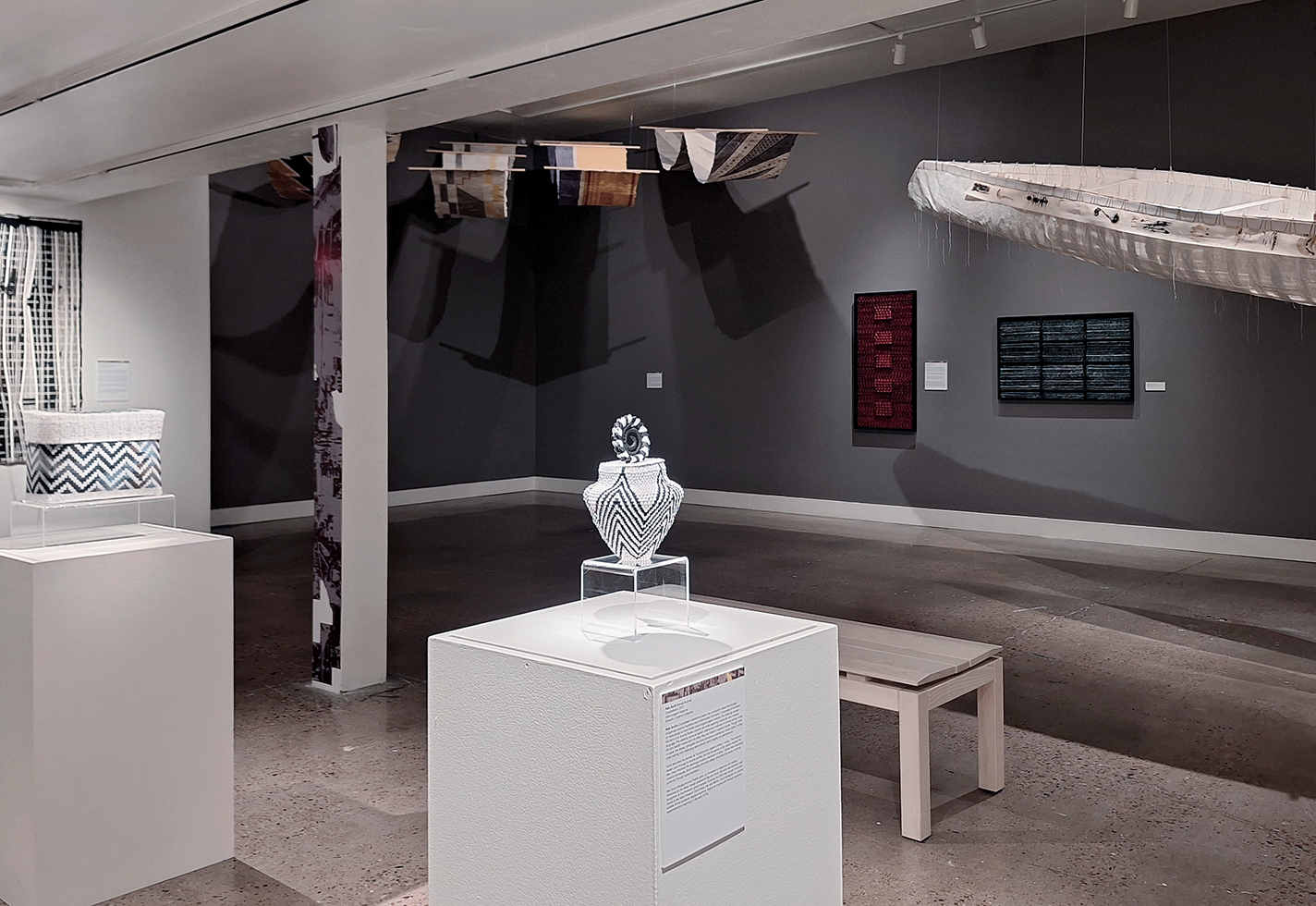
Among the exhibition’s more visually imposing works is Canoe (2003) by Bonnie Devine (Serpent River First Nation, Anishinaabe, and Ojibwa). Suspended from the ceiling, the sculpture takes the form of an Anishinaabe canoe used for rice gathering. Devine sewed together hundreds of pages from her MFA research and writing on treaties, ecological knowledge, and Indigenous craft practices. Together, the pages overlap to form a thin, woven structure that appears almost weightless. Its fragility—including its inability to be placed in water without breaking down—reflects the precarity of Indigenous land rights. “We cannot ignore that 99 percent of the treaties between Native nations and the US were broken,” says Well-Off Man. 

Works such as Leah Mata Fragua’s Making Big Steps with Corn (2025), Jaune Quick-to-See Smith’s The Changing Shape of America (2000), and Chris Pappan’s Scars of History I (2018) also address questions of border and homeland. “For Indigenous peoples, political borders are meaningless,” Well-Off Man says. She points to the role of maps in restricting inter-tribal movement. “For centuries, they have freely roamed Canada and North America. It’s especially problematic when you look at how tribes are affected at the US-Mexico border.”

Right to Remain(s), Goshorn’s funerary basket, is constructed in a traditional Cherokee single-weave using unconventional materials inscribed with reflections from Native community members. Well-Off Man explains that Goshorn asked participants to consider “belonging and what it means if remains of ancestors are not in the homeland but in private and institutional collections.” One handwritten line reads, “This is our land mixed with our blood.” Another reads, “Earth is the dust of the bones of our ancestors.” Here, the notion of remains takes on material form, subject to the same conditions of exposure and decay. Ultimately, Goshorn’s Right to Remain(s) distills the exhibition’s central premise that paper, long used to control, can also be mobilized as a material of resistance and sovereignty.

Learn more about select artists from this region of the United States on the Homo Faber Guide.

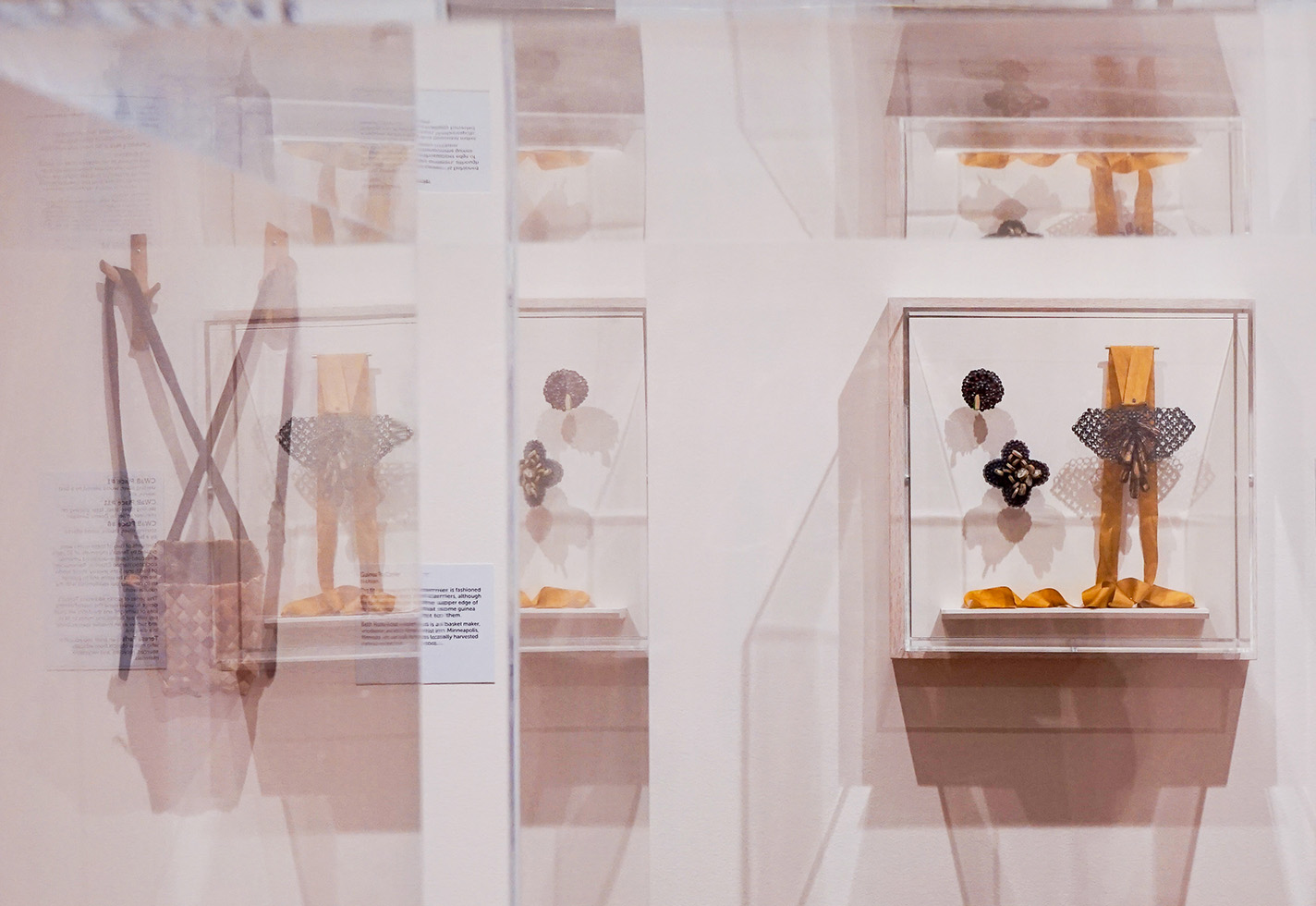
Photo courtesy of IAIA MoCNA

Installation view of Paper Trails at the Museum of Contemporary Native Arts in Santa Fe.

Jacqueline Huynh Young is a Vietnamese American artist and writer based in Los Angeles.

Learn more about Paper Trails online.

Website

This article was made possible with support from the Windgate Foundation.

Before you go!

We believe that making creates a meaningful world, and we hope you do, too. Deeply researched and impactful journalism on the craft community is in short supply. At the same time, being featured in craft-centered media and articles can have a major effect on a maker’s or artist’s livelihood, particularly those who are just starting in their career. You can help support our mission and the work of makers around the country by becoming a member or by making a gift today.

Thank you!
American Craft Council