Craft Around the Country

YehRim Lee's Ceramics Practice Blooms in the Desert

From her home studio near Joshua Tree, California, the South Korea–born sculptor builds towering clay sculptures—and communion with nearby artists.

By Jacqueline Huynh Young
July 13, 2026

Photo courtesy of YehRim Lee

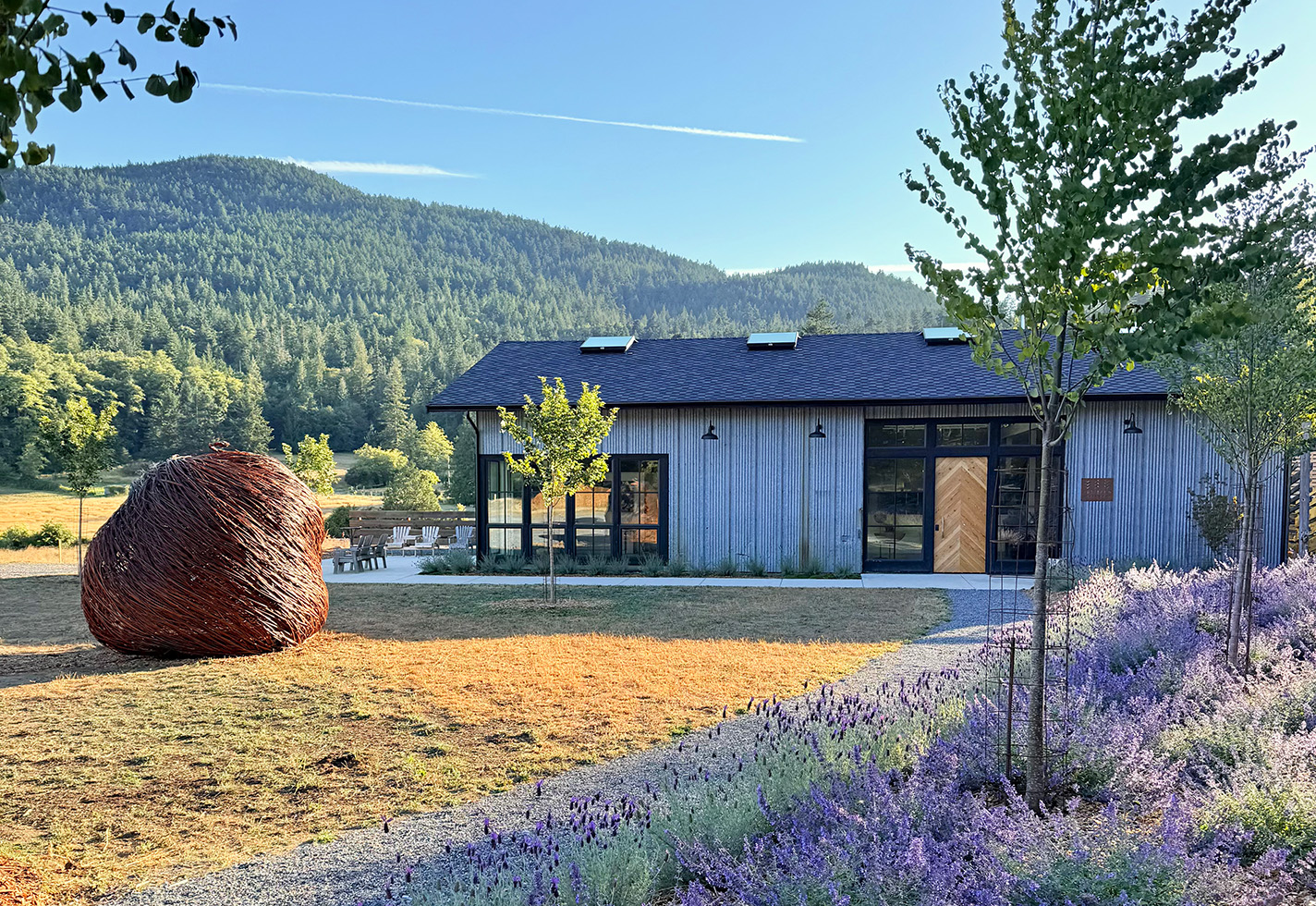
YehRim Lee's Joshua Tree, California–based home and studio houses her improvisational clay sculptures.

Flipping through the pages of a coffee-table book on Korean temples given to her by her mother, YehRim Lee points to photographs of wooden doors covered in geometric latticework and painted floral motifs. “We call this flower pattern a kkotsal pattern,” she says. “I remember going to the temples all the time.” 

In the ceramist’s California high desert studio near Joshua Tree, California, those designs materialize in unexpected ways. Patterns repeat, disappear, and reappear across the surfaces of her sculptures, and geometric incisions reference the latticework of Buddhist temples without directly reproducing it. “I don’t have the patience to carve one-to-one, but I always loved those ideas,” Lee says. 

Their influence can be seen throughout Unruly Reverence, Lee’s solo exhibition at Gallery Koen in Los Angeles’s Koreatown, on view through September 20.

Photo courtesy of Gallery Koen

Lee and her son in the studio.

Raised in Cheong-ju, South Korea, about an hour and a half southeast of Seoul, Lee grew up surrounded by clay. Her mother, KyungHee Son, works in porcelain, decorating dinnerware with inlaid botanical imagery, and her father, renowned master ceramist Kang-Hyo Lee, makes traditional Korean onggi, large earthenware vessels used for fermenting and storing food. 

After studying at the Korean National University of Cultural Heritage, Lee apprenticed under her father for four months. He insisted she master the fundamentals. “He says having a skill makes you confident in ceramics,” she says. “You can do everything with the right skills.” 

Lee, however, wanted to see where else the material could take her. Soon after her apprenticeship, she moved to California to study at California State University, Long Beach, where she flourished under the mentorship of ceramist Tony Marsh. In the university’s library, Lee immersed herself in art books, gravitating toward artists who challenged conventional ideas of volume, scale, texture, and abstraction. “I wrote down all of their names and tried to put all those things in my work,” she says.

Photo courtesy of Gallery Koen

Installation view of Unruly Reverence, Lee's show at Gallery Koen in Los Angeles's Koreatown.

“Having a skill makes you confident in ceramics. You can do everything with the right skills.”

— YehRim Lee

At the same time, she wrestled with a question familiar to many artists raised within strong traditions: Was she supposed to continue making Korean ceramics, or could she pursue the experimental forms that had begun to occupy her mind?

It took some time, but Lee eventually stopped seeing those choices as mutually exclusive. “Even if you’re not making traditional work, it doesn’t mean you’re not Korean,” she says. Her father agrees. He cares less about what she makes than whether she makes it her own. 

The way she builds, though, still comes from him. Many of Lee’s sculptures are made using the onggi technique, wherein thick ropes of clay (tarayeom) are stretched by throwing them against the floor. Rather than a loud bang, the impact is more like a gentle swoosh. Each rope is then added layer by layer, with its lower edge smeared and compressed into the wall beneath it to strengthen the structure.

This method allows Lee to build big quickly, resulting in monumental sculptures that seem to defy gravity. Throughout her studio, puffy scalloped edges bulge outward, architectural buttresses fold over themselves, and sunset-colored glazes melt into swirls of greens and creams. Some surfaces resemble clouds, while others feel washed by years of desert wind. Though grounded in Korean ceramic traditions, the sculptures possess a sense of openness and experimentation often associated with the West Coast. “It’s very California,” she says. 

Photo courtesy of Gallery Koen

Lee stretches out a thick rope of clay (tarayeom) on the floor of her studio.

  • Photos courtesy of Gallery Koen

    Lee works on her large works in clay.

After a series of long-term residencies, Lee and her husband, poet Frank Montesonti, settled down in the high desert and had two children. There, they built a life around her ceramics practice, making room for a studio, a solar-powered kiln, and a shipping container large enough to store her growing body of work. She jokes that the container determined where they ended up. “We needed land,” she says.

The property has become an extension of her studio. Chairs gather in circles on the sand. Sculptures hang from the exterior of sheds. Layers of pink and green glaze—generated over multiple firings—echo the colors of creosote and evening sky. “My work shifted with my lifestyle,” she says. “Coming here and redoing the house, I’m thinking about furniture and interiors.”

Her growing interest in the relationship between sculpture and domestic life eventually opened the door to a lucrative partnership with influential interior designer Kelly Wearstler. A handful of side tables for Wearstler’s Terra collection currently sit in Lee’s studio, ready to be glazed and fired, while more are being prepared for bisque.

Photo courtesy of YehRim Lee

Lee partnered with interior designer Kelly Wearstler to create the sculptural Terra collection for Kelly Wearstler Gallery.

When asked how the landscape influences her work, Lee points to areas on some newer pieces where the glaze stops abruptly, exposing the raw ceramic. “Maybe that’s from the desert,” she says. Then she laughs. “Actually, I just made that up.”

What feels more certain is the community she’s found there. Last week she met a harpist, and before that, a famous dance choreographer. Prior to moving to Joshua Tree, Lee says she felt somewhat lost. Now she finds herself surrounded by people who encourage her to push herself. “It feels like the entire town is a residency,” she says.

For Unruly Reverence, the walls at Gallery Koen have been painted to match the walls inside Lee’s home. Sand remains tucked into the crevices of some pieces, remnants of the desert carried into the city. She attempts to remove what she can before the opening reception, but, she says, “You can’t ever get rid of it. It’s always there.”

The same could be said for the temple doors. Years later and thousands of miles away, their patterns continue to find a way into her work.

YehRim Lee is a part of Homo Faber Guide

Photo courtesy of YehRim Lee

While building her sculptures, Lee carves away sections and reattaches them at unlikely angles, testing how far a form can be pushed before it gives way.

Jacqueline Huynh Young is a Vietnamese American artist and writer based in Los Angeles. 

Learn more about YehRim Lee and her exhibition at Gallery Koen.

Artist Website Gallery Website

This article was made possible with support from the Windgate Foundation.

Before you go!

We believe that making creates a meaningful world, and we hope you do, too. Deeply researched and impactful journalism on the craft community is in short supply. At the same time, being featured in craft-centered media and articles can have a major effect on a maker’s or artist’s livelihood, particularly those who are just starting in their career. You can help support our mission and the work of makers around the country by becoming a member or by making a gift today.

Thank you!
American Craft Council