Interviews & Profiles

The Queue: Tabitha Arnold

Tabitha Arnold’s tapestries pulse with the energy of labor and of social and economic struggle.

In The Queue, the Chattanooga, Tennessee–based artist shares about hope and solidarity, the importance of craft artists in political struggle, and her journey from paintings to textiles. 

Interview by Jon Spayde
May 6, 2026

Photo courtesy of the artist

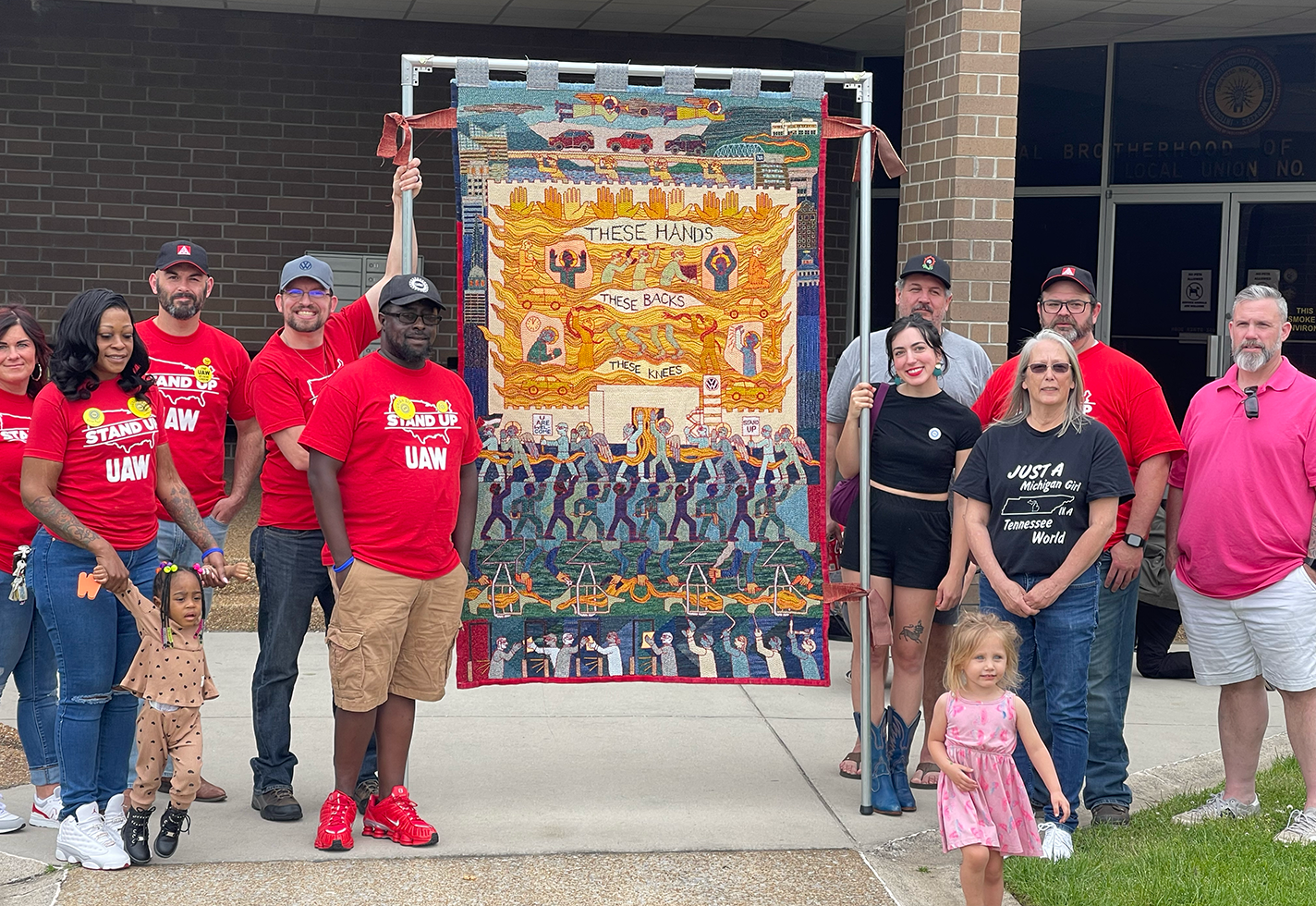
Together with Volkswagen workers from UAW Local 42, Tabitha Arnold (to the right of the tapestry) holds her tapestry These Hands, 2024, punch needle embroidered wool yarn on linen cloth, 72 x 48 in.

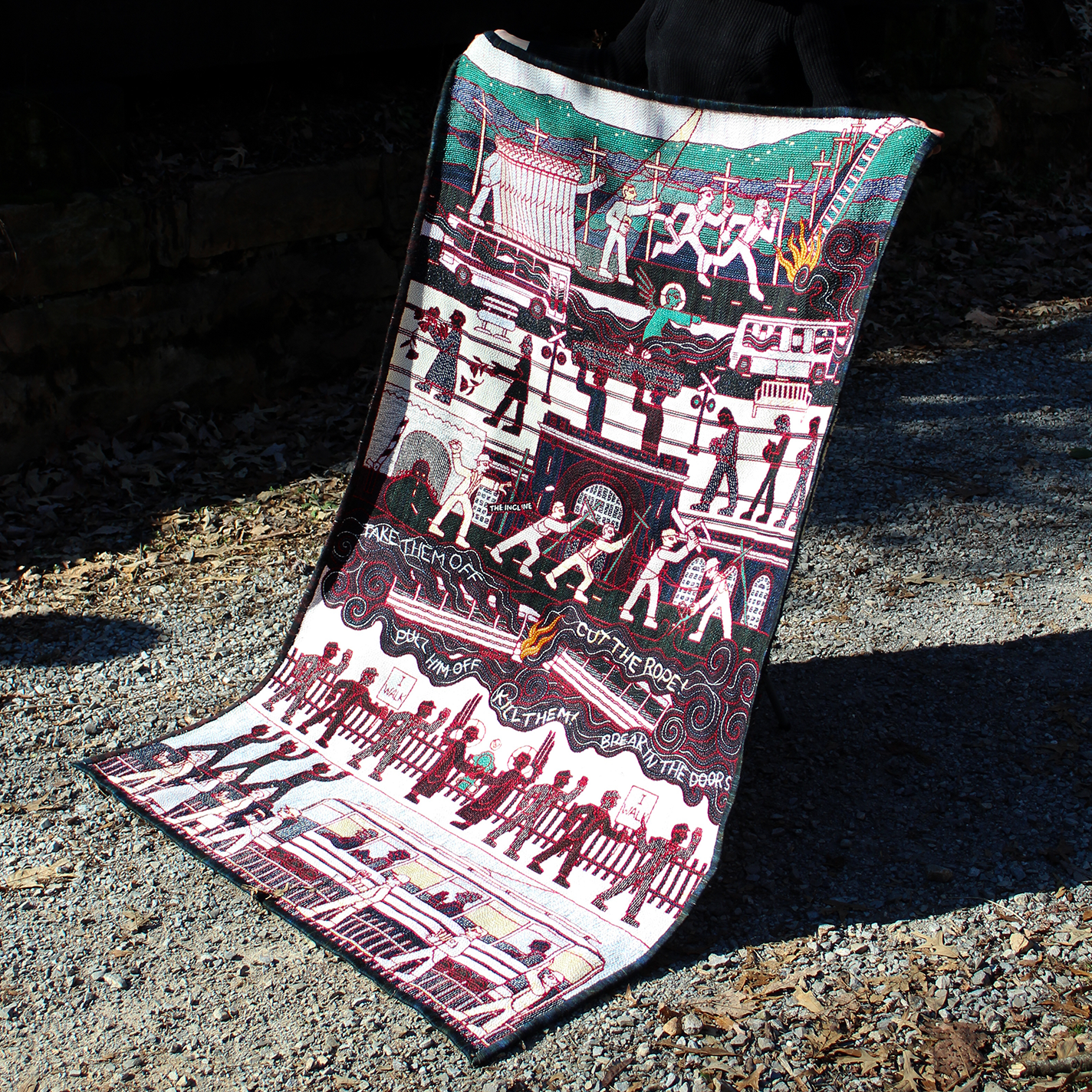
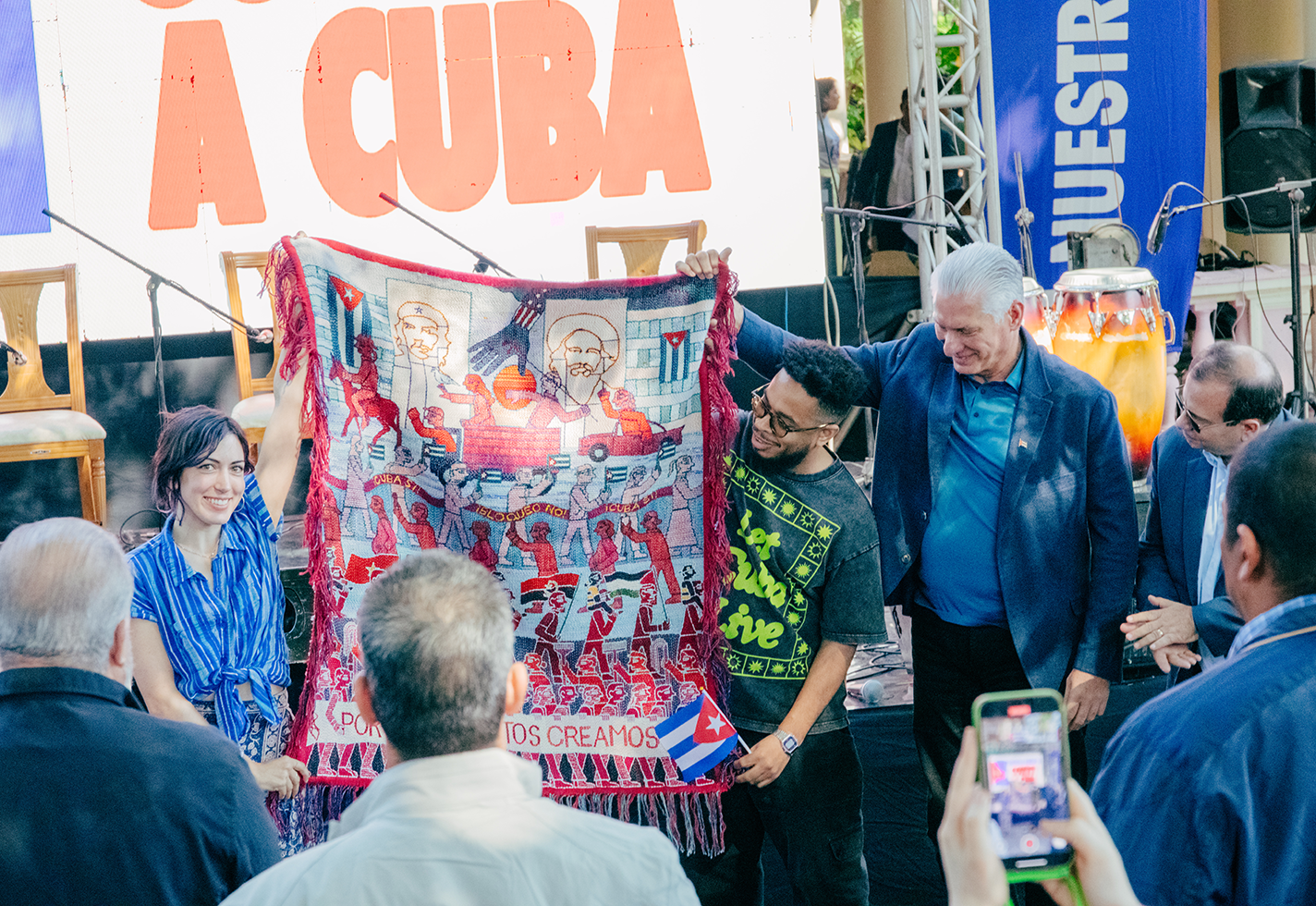
Tabitha Arnold’s tapestries pulse with the energy of labor and of social and economic struggle. Colorful figures join in factory work, picket lines, and demonstrations, and the visual results are both brilliantly decorative and deadly serious about the history and hopes of labor in America, including in her native South. 

Arnold was born in Chattanooga, Tennessee—where she lives and works today—and trained as a painter at the Pennsylvania Academy of Fine Arts in Philadelphia. She turned to weaving, then discovered the subject matter that animates her work today after becoming involved in a movement to unionize café workers. Her depictions of labor activism range from the historical to the contemporary; as an organizer, she is deeply involved with the renascent labor movement, and is the resident artist at Dissent, a leading journal of leftist theory and practice. 

Arnold has held solo exhibitions at Field Projects in Manhattan, the Worker’s Art and Heritage Center in Hamilton, Ontario, the List Gallery at Swarthmore College, and the Institute of Contemporary Art Chattanooga. Her works are held in several collections, including the Museum of Fine Arts, Boston, and Dom Museum Wien in Vienna. She was the recipient of the 2025 Southern Prize for Visual Art from South Arts.
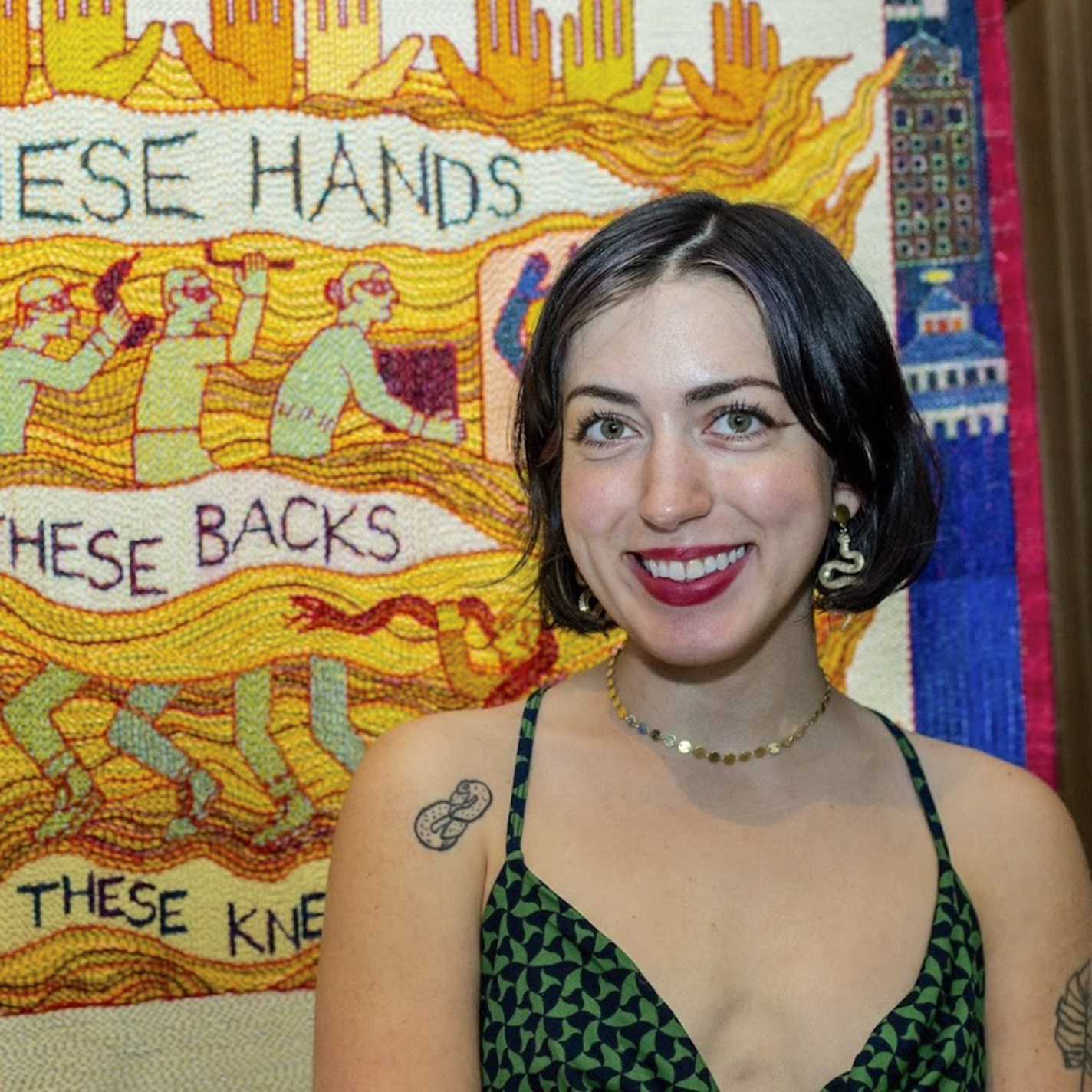
Photo courtesy of the artist

Tabitha Arnold.

How would you describe your work and practice in 50 words or less?

I am a punch needle embroidery artist making tapestries about the labor movement and socialist struggle, past and present, in my community in the US and internationally. I use my textile craft medium to create monuments that feel like new historical artifacts for the working class.

Do you belong to a craft lineage? Who have been your greatest influences and teachers, directly or indirectly? 

I am inspired by generations of women crafters in my family, especially my grandmother, who has been making cross-stitch embroideries for decades. I am also inspired by the long history of craft artists engaging in political struggle, such as arpillera makers in Chile and war rug weavers in Afghanistan. I credit my first inquiries into textile art to Ann Hamilton, and Sheila Hicks was an early inspiration when I began teaching myself tapestry weaving on a lap loom.

Photo by Tori Vintzel

I Walk, 2025, punch needle embroidered wool yarn on linen cloth, 72 x 48 in.

“I didn't understand what it was like to love a process more than an end result until I stumbled into tapestry weaving.”

— Tabitha Arnold

You have a BFA in painting. What brought you to textile art?

By the time I went to college to study painting, I had been disconnected from the joy of artmaking for many years. I demonstrated talent and technical skill, but I did not love making paintings, and I didn’t understand what it was like to love a process more than an end result until I stumbled into tapestry weaving. I pursued textile art because it felt meditative and restorative, while at the same time opening me up to curiosity and experimentation.

What are the greatest challenges in making tapestry and punch-needle embroidery?

My greatest challenge is starting a piece, and the next greatest challenge is not abandoning a piece in the middle. I’ve learned to confront perfectionism and fear of failure by forcing myself to start stitching without knowing exactly where I’m going. I know there will inevitably come a point where I think the work is horrible and unsalvageable, and I have to force myself to finish it anyway. This happens every single time I make something. 

Photo courtesy of the artist

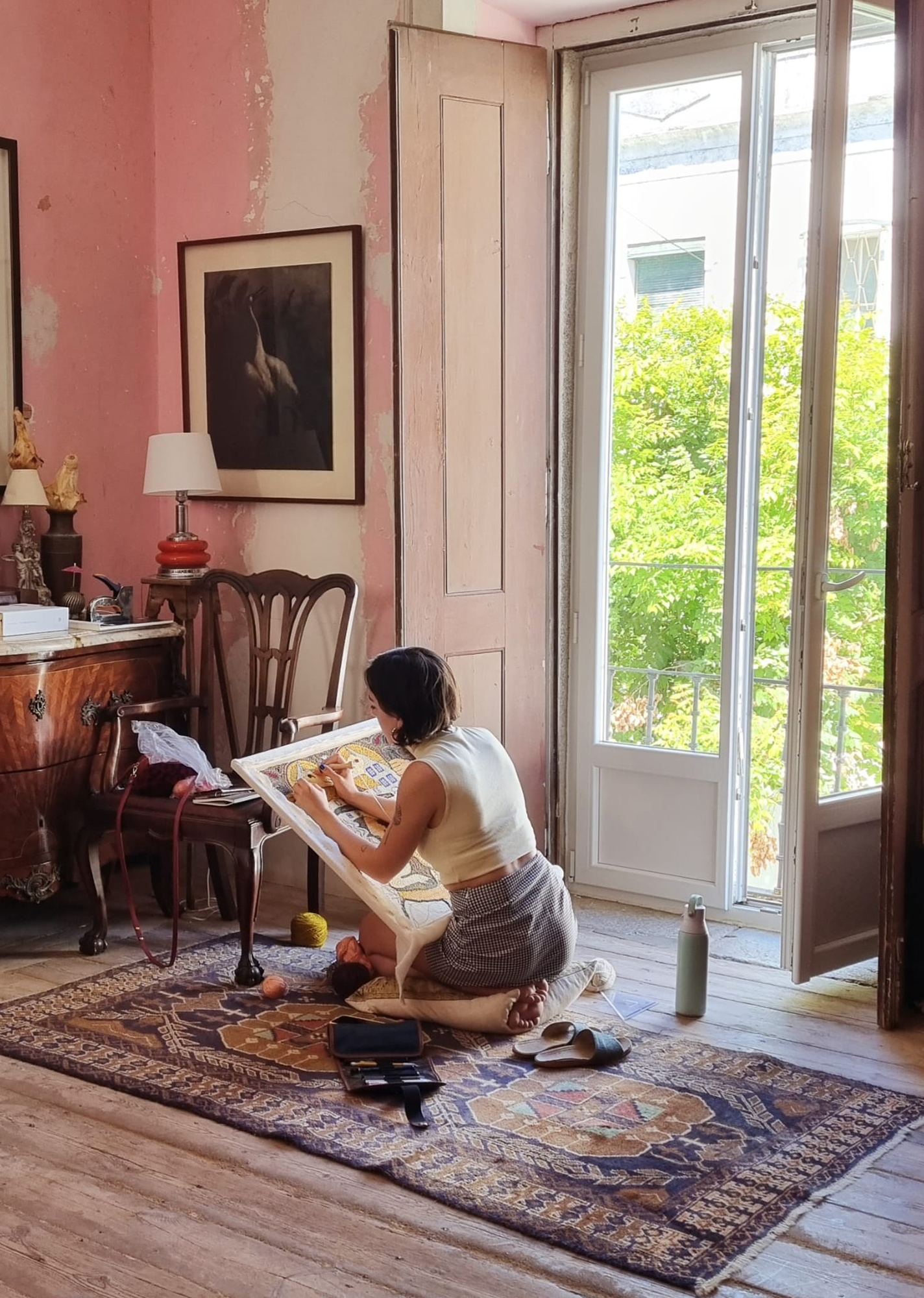
Arnold in her studio in 2022.

  • Photo courtesy of the artist

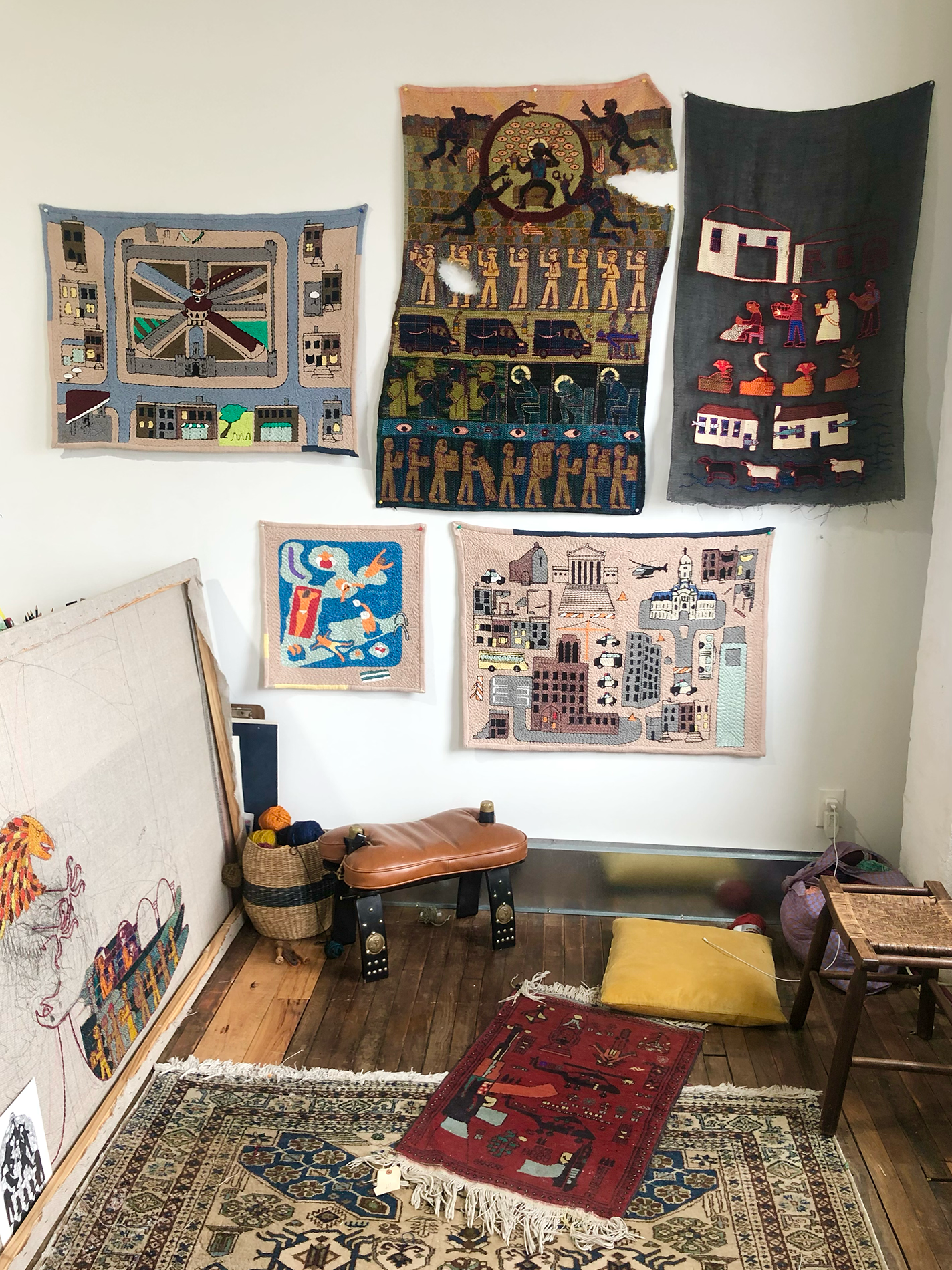
    Works in progress and completed works in Arnold's studio, 2022.

  • Photo courtesy of the artist

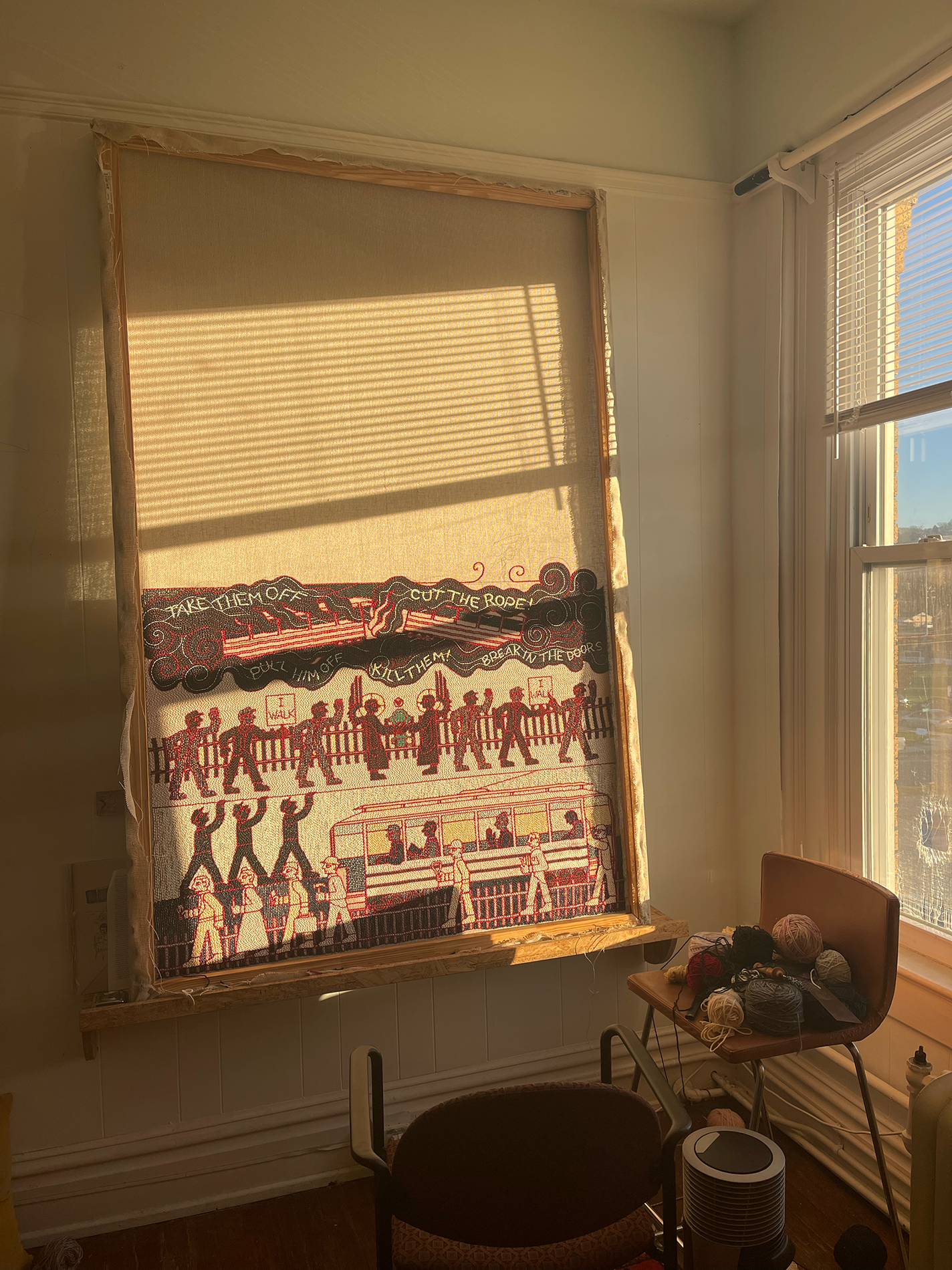
    I Walk in progress, 2025.

You are deeply committed to the labor movement and socialist politics. How do they sustain you, and what do you hope to convey about them in your work?

I’m driven to capture the labor movement because it gives me hope for the future. I want to bottle that feeling and share it with my community as we push through a dark, demoralizing historical moment. I want my work to demonstrate that people are not alone, that no one can take solidarity away from us, and we are able to pick up the same tools our ancestors used in the struggles that came before us.

If you were to furnish your home or studio with craft art, which craftspeople’s work would you include? 

I have two Afghan war rugs in my studio right now and I’m always looking for more. I would like to sleep under a quilt from the Gee’s Bend collective, and I would love to have a piece of Palestinian tatreez embroidery on my wall.

Which craft artists, exhibitions, or projects do you think the world should know about, and why?

I recently learned about the Social Justice Collaboration Quilts Project, and I would love to see more people get involved in this incredible anti-carceral art movement.

Photo by The People’s Forum

Arnold (left) holds her 2025 tapestry Primero de Mayo. She is pictured with Miguel Diaz-Canel, President of Cuba, and Manolo de los Santos.

Jon Spayde is a writer and editor in Saint Paul, Minnesota. A former contributing editor to American Craft, he writes on art, psychology, education, and personal growth for a number of regional and national publications.

Learn more about Tabitha Arnold's work online.

Website Instagram

Before you go!

We believe that making creates a meaningful world, and we hope you do, too. Deeply researched and impactful journalism on the craft community is in short supply. At the same time, being featured in craft-centered media and articles can have a major effect on a maker’s or artist’s livelihood, particularly those who are just starting in their career. You can help support our mission and the work of makers around the country by becoming a member or by making a gift today.

Thank you!
American Craft Council