Makers

The Queue: Kristin Colombano

Ancient technique and dreamy landscapes collide in Kristin Colombano’s painterly felted textiles.

In The Queue, the San Francisco–based owner of textile brand Fog & Fury talks about her extensive felting tool kit, her favorite wools, and the evocative patterns in nature that inspire her work.

By Shivaun Watchorn
January 14, 2026

Photo by Maren Caruso

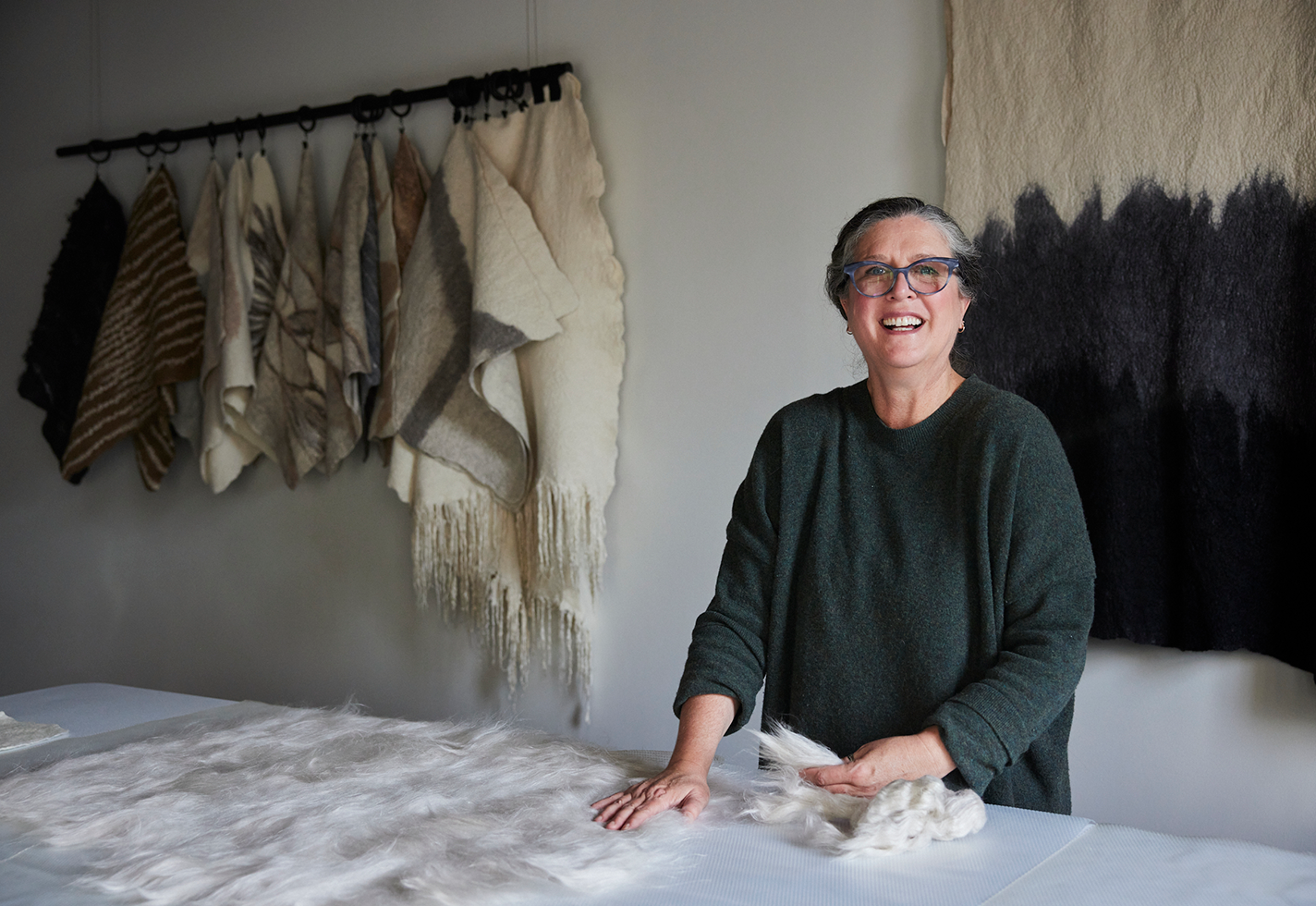
Kristin Colombano working in her San Francisco studio. Felted textiles hang on the wall behind her.

Ancient technique and dreamy landscapes collide in Kristin Colombano’s painterly felted textiles.

Kristin Colombano became entranced by felt while on a trip to Mongolia in 2010. After sleeping on a steppe in a cozy, felt-covered yurt, she walked into a souvenir shop in Ulaanbataar that was playing a video showcasing the 5,000-year-old method of wet felting. A few years later and some 5,800 miles away, she enrolled in a wet-felting workshop in San Francisco, where she still lives and works. Colombano, who was working as a photographer at the time, took to the physically demanding process immediately. “I love most mediums,” she says. “I fall in love easily with materials and immediately want to play and explore their possibilities.” 

Today, Colombano uses the wet-felting technique—combining just water, soap, and friction to make wool fiber into felt—and a veritable library of wools to create her line of bespoke textiles, which she sells under the name Fog & Fury. Her pillows, blankets, upholstery fabric, and wall hangings—whose muted palette and varied textures evoke the cloudy environs of Northern California—are in demand by designers and decorators, who layer her lush home goods into their projects. Deborah Bishop wrote about Colombano’s work in “Felting with Feeling” in the Winter 2026 issue of American Craft.
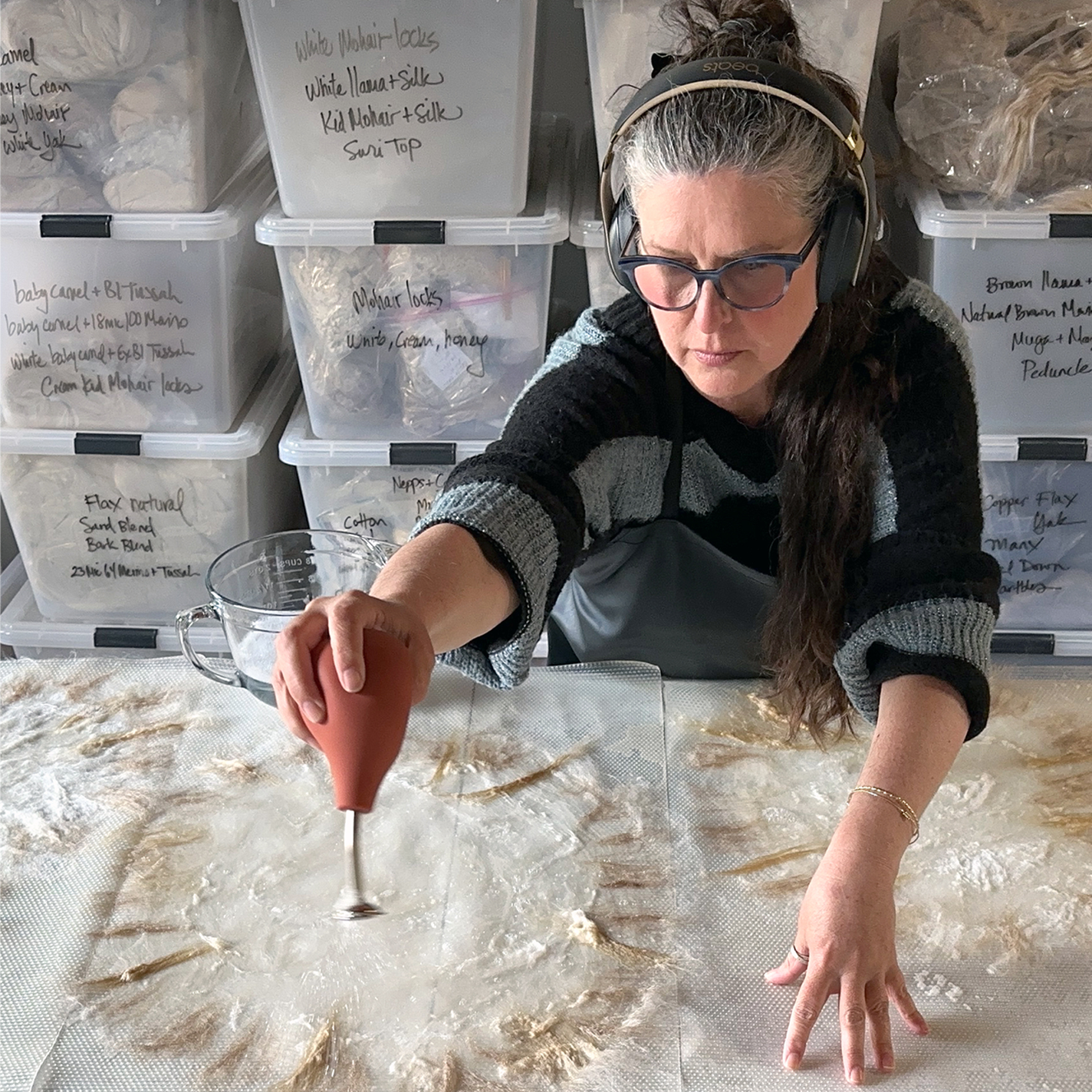
Photo courtesy of Fog & Fury

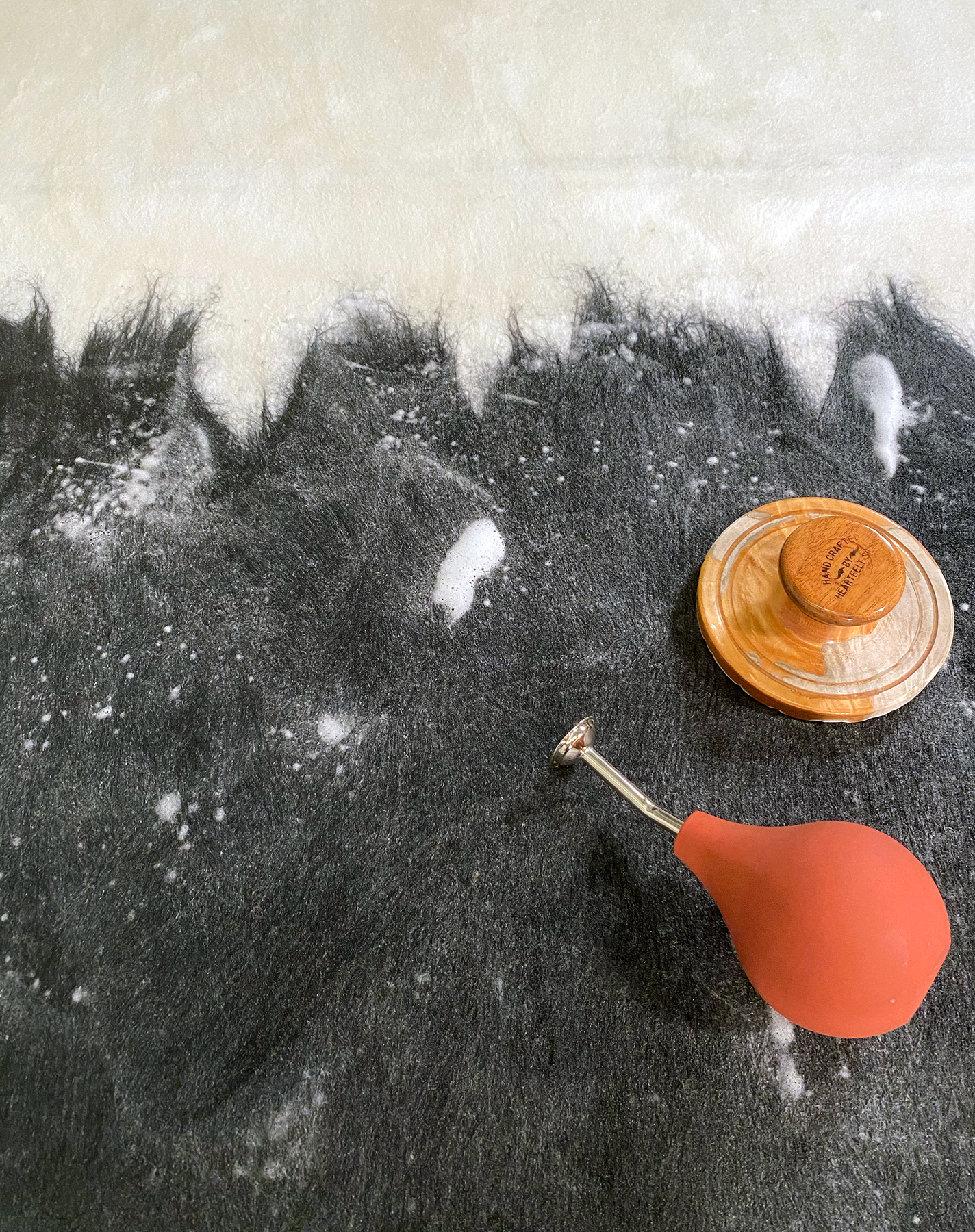
Colombano lightly wet-felts pieces of wool, cashmere, mulberry, and Muga silk using a ball brause. The pieces will be layered and felted into a Lunaria blanket.

How do you describe your work or practice in 50 words or less?

I craft handmade felt textiles for interiors using the ancient wet-felting method. I transform raw wool into sophisticated textiles by manually fusing layers of fiber using just warm water, soap, and friction. The resulting organic compositions are as visually beautiful as they are deeply tactile.

Tell us about sourcing materials for your works in felt. Where do you procure wool? 

I attend regional fibershed events to source from local shepherds and farms. I have found exceptional mohair and soft Romney [an English sheep breed] to work with in Northern California, as well as other states. I also source wool from the UK. My favorites are from British sheep breeds such as Bluefaced Leicester, Manx, and Shetland. Italy has great dyed wool, silk, and flax.

What about the dyes?

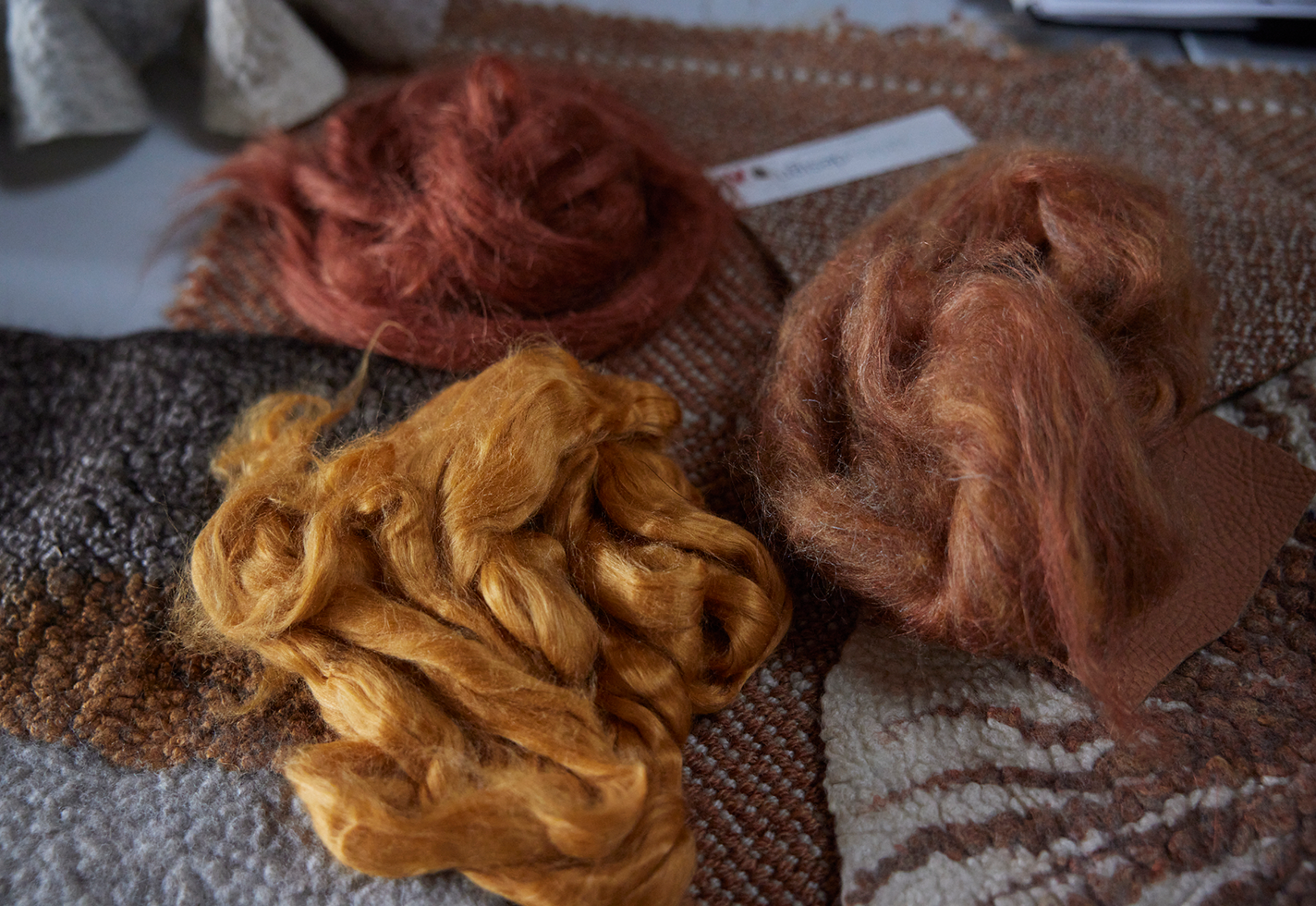
I have done both botanical and acid dyeing. I appreciate that both techniques require their own  expertise! For now, I prefer to procure archival (typically acid-dyed) combed roving so that it’s ready to work with. I think in color like an artist does with paint. I blend hues and a variety of natural fibers to create my own material palette.

Photo by Maren Caruso

Bundles of flax (top), silk (left), and a hand-carded wool color match (right) sit atop samples of Colombano's Terrain and Flare felts.

“I think in color like an artist does with paint.”

— Kristin Colombano

Where is the wildest place you’ve sourced fiber from?

I wish I could say Tanzania or Greenland, to name some unexpected exotic locations. But, alas, I haven’t sourced from anywhere too wild yet. I have been given some wild, unusual fibers such as qiviut and bison. I’ve also had more than a few people ask if they could give me their dogs’ or cats’ fiber to work with.

What are your go-to tools for felt making?

My ball brause is beloved. It’s a handheld sprinkler used to gently and evenly wet wool surfaces before felting. It was originally created to water bonsai plants and has been co-opted by us wet felters. The palm washboard was designed specifically for wet felting; it has a textured surface that aids in rubbing fibers together. I use a nap riser brush as a finger flicker to carefully open curly locks, and I have sharp pointed tweezers stashed around my studio to pick out bits of grass or burrs that are stuck in the fibers—charming reminders of farm life!

Photo courtesy of Fog & Fury

A ball brause (bottom) and palm washboard (top) are among Colombano's favorite felting tools.

“I’ve had more than a few people ask if they could give me their dogs’ or cats’ fiber to work with.”

— Kristin Colombano

You point to your surroundings as inspiration for your work. Tell us about specific landscapes and tableaux that inspire you. 

I am inspired by California’s diverse landscapes and its magical light. I feel fortunate to live near the coast—gazing into the sea’s horizon is my minimalist nirvana. I am mesmerized by nature’s patterns, such as the effects of water and wind on sand, the intricate designs of shells, shifting cloud formations, and the rugged bark of redwoods and desert palms. I think fractal-based designs are beautiful when translated into felt.

If you were going to design a dream room in your house, which craftspeople’s work would you include?

I would love a Fold Sofa with mohair upholstery by John Pomp and a brutalist chair such as Rick Owens’s Double Bubble or Curial. I would commission a massive custom bronze Panthalassa cabinet from Tuell & Reynolds and a Tourbillon coffee table in parchment or shagreen by Alexander Lamont. For the floor, I’d get a huge, plush, made-to-order artist collab rug by Christopher Farr and pair it with Rosemary Hallgarten’s dreamy dip-dyed drapery. For lighting, I like the pale transparent colors of Gabriel Scott’s chandeliers, and I’d add a ceramic-framed mirror by Peter Lane for the wall.

Photo courtesy of Fog & Fury

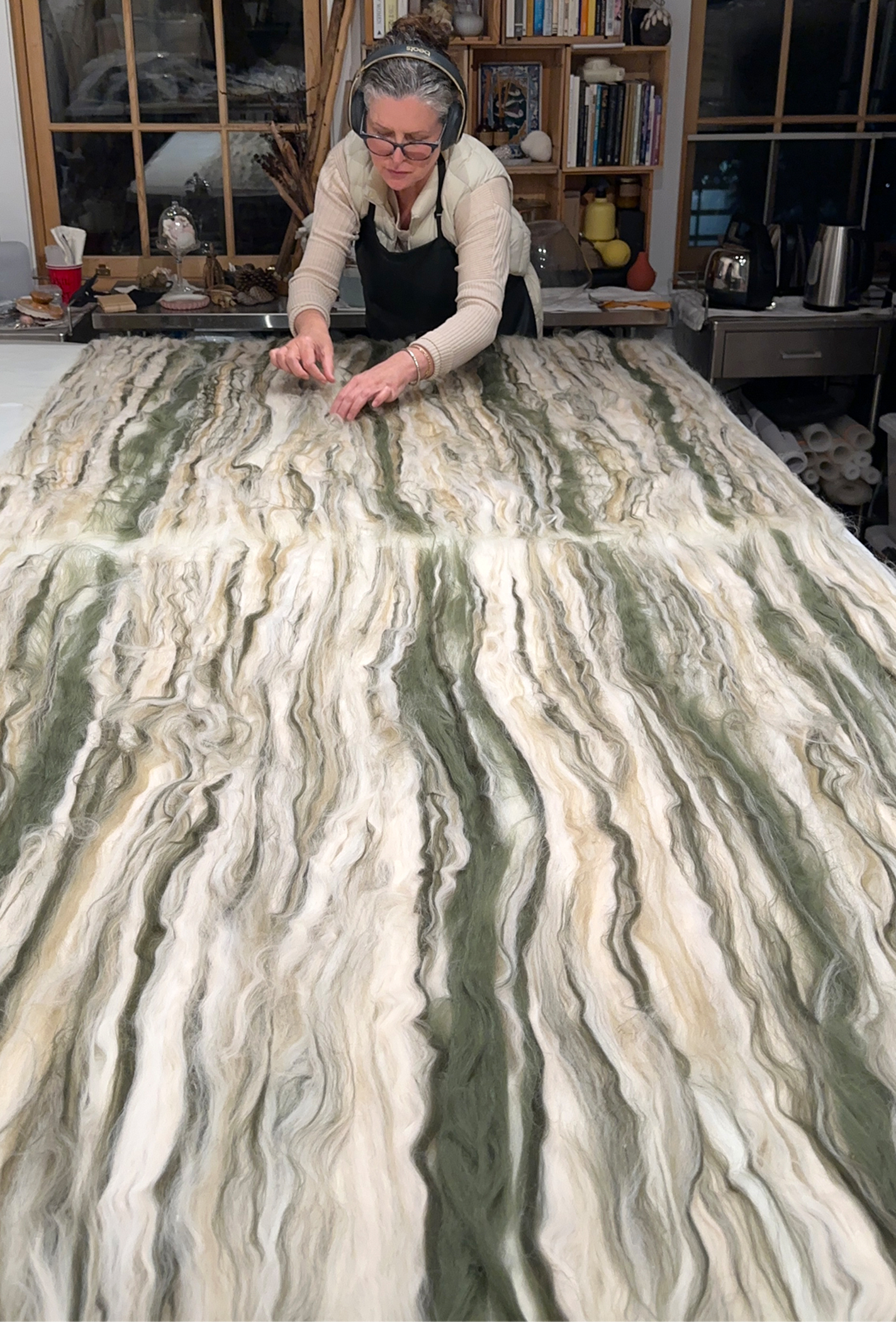
Colombano lays out green, ecru, and cream fibers for her Marbled Striation felt.

Which craft artists, exhibitions, or projects do you think the world should know about, and why?

I’m currently obsessing over Joyce Lin’s sculptural furniture, particularly her Ghostwood chair and table and Root Chair. I find her work—which explores raw material transformation at the intersections of natural and human-made, authentic and artificial, and illusion and intent—intriguing. She has an exhibition called Hypernatural up right now in New York City at R & Company.  

I am charmed by the embroidery and unusual upholstery work of Casamento; a pair of chairs made of baobab wood and palm pods to honor the Tawana tribe of the Okavango are showstoppers. I covet the natural hues and chunky, nubby-textured, handspun woven works in yarn by Celine Cannon. She balances humble material design with rich tactile details.

I admire the root-based textile tapestries of Diana Scherer. Her work seeks to be a sustainable alternative to traditional fabrics—it sequesters carbon dioxide and grows without electricity or synthetic chemicals. Finally, I find Loumi Le Floc’h’s transparent eggplant-skin tapestries seductive and impressively clever in their use of a discarded recipe ingredient.

What are you working on right now?

I’m currently making commissioned work using my Terrain felt as upholstery for a bench, a custom color-match job of seven pillows in Striation, and a trio of square and round pillows in Color Field. In between custom jobs, I am always innovating new designs. Right now, I’m playing with new directions in color, pattern, and surface. I’m experimenting with hand carding wool hues, adding plant fibers, making my own recipes, and layering to create beautiful felted effects. I’m also working on expanding additional nature-based designs using inclusions to explore new textures and push the power of felt’s material-holding capacity.

Photo courtesy of Fog & Fury

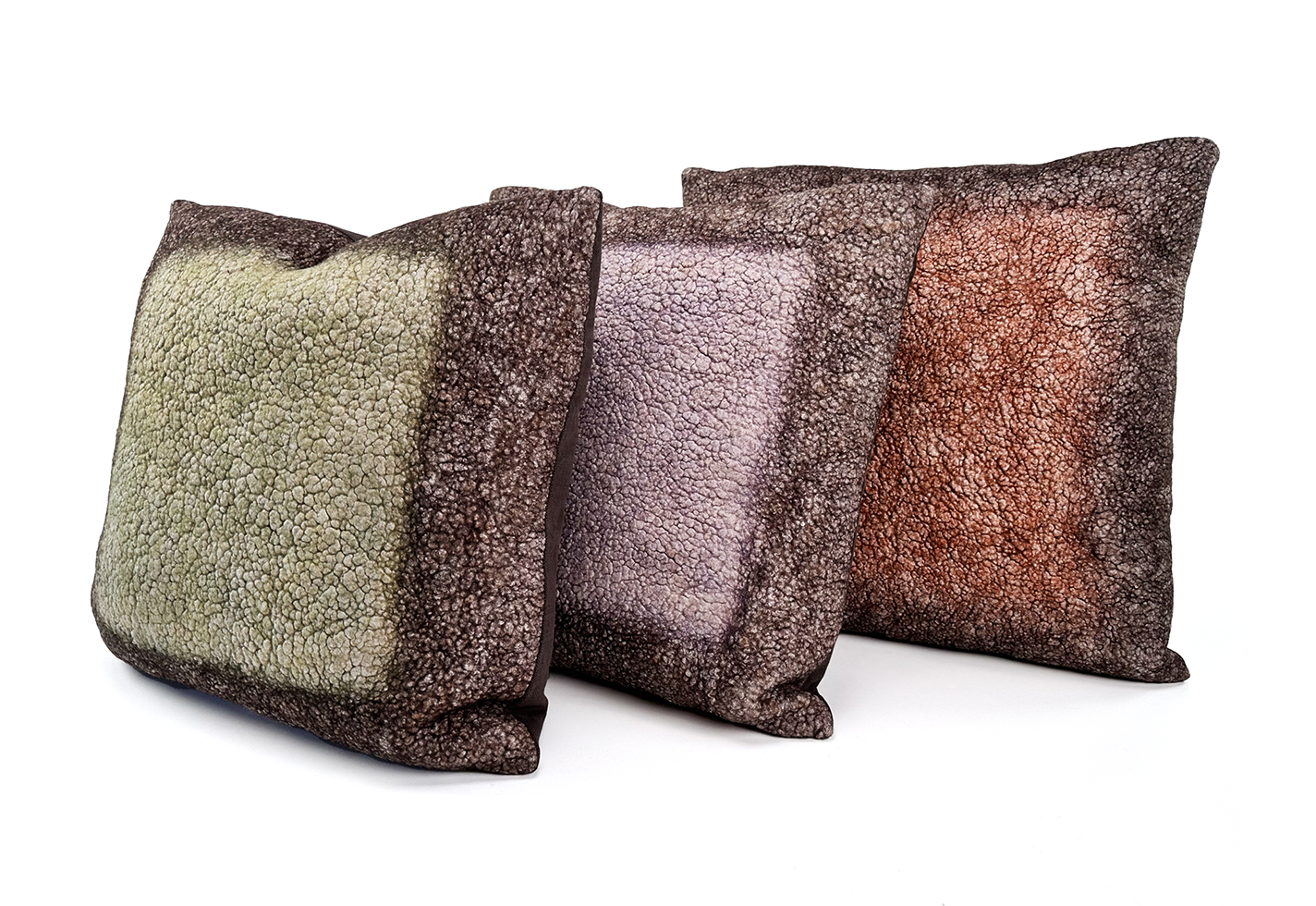
Color Field pillows in three colorways. From left: olive and laburnum, lavender and heather, rust and amber. Each pillow is 22 x 22 inches and made from wool, camel, and silk.

Shivaun Watchorn is associate editor at the American Craft Council.

Check out Fog & Fury online.

Website Instagram

Before you go!

We believe that making creates a meaningful world, and we hope you do, too. Deeply researched and impactful journalism on the craft community is in short supply. At the same time, being featured in a national publication can have a major effect on a maker’s or artist’s livelihood, particularly those who are just starting in their career. You can help support our mission and the work of makers around the country by becoming a member or by making a gift today.

Thank you!
American Craft Editors

Each edition of The Scene you’ll get an in-depth look at craft in a single city. Published twice per year, this special section goes beyond traditional travel articles. Instead it offer in-depth look at a city’s craft scene through the voices and perspectives of its artists.

In the following pages you’ll find lists of artists and craft-related spaces in New Orleans that are based on the recommendations of local contributors. This coverage is not comprehensive and we encourage you to continue exploring more of New Orleans’s craft scene.

In this Scene:

ARTIST CONTRIBUTORS:
Hannah Chalew, Charles DuVernay, Pippin Frisbie-Calder, Matthew Holdren, MaPó Kinnord, Seguenon Koné

SPOTLIGHTS:
Backstreet Cultural Museum, Music Box Village, Jeff Poree, Darryl Reeves, Dutch Alley Artist’s Co-op

EXPLORE BALTIMORE:
Where to Buy Supplies, Museums, Artists’ Spaces, Schools and Workshops, Galleries, Studios, Markets, Bars, Clubs, Restaurants

Introduction

by Katy Reckdahl

New Orleans craft is not static. It doesn’t tend to sit on a counter or hang on a wall. “It comes to life,” says Charles DuVernay, whose beaded tapestries are drawing crowds to New York City galleries these days.

Like many New Orleans artists, his craft is only one part of his life. “I don’t see myself as ‘artist Charles,’” says DuVernay, who sews mostly at night after a day of working on the Mississippi River, where he tests the quality of sugarcane that arrives by barge. “Because in New Orleans, everybody does art.”

As sculptor and visual artist Hannah Chalew puts it, “There is a spirit of creativity endemic to this place.”

Long a gathering spot for Native Americans, New Orleans was settled by the French in 1718 on a high-ground rectangle along the Mississippi River that became the French Quarter. The port drew people from all over, including the Eastern Seaboard, Europe, Latin America, and the Caribbean, particularly the French colony of Saint-Domingue, now Haiti. New Orleans became known for its trade of cotton, sugar, and human cargo, sold here in the country’s largest slave market.

Much of the city’s well-known architecture was built either by enslaved carpenters and artisans or by French-speaking Afro-Creole free people of color, known as gens de couleur libres, who made up more of the population of New Orleans than anywhere else in the nation and whose story is still told everyday by the docents at Le Musée de f.p.c. on Esplanade Avenue.

As a child, DuVernay watched his grandfather, Otis DuVernay, a well-known master carpenter, create dramatic arches and intricate, decorative trim for both fancy French Quarter townhouses and the humble shotgun-style houses that make up most of the streetscape in his native 7th Ward, a short walk from the Quarter.

Many 7th Ward families were, and still are, headed by craftspeople, seamstresses, and jazz musicians. One can argue that the city itself is a work of art that constantly requires skilled tending, fixing, and restoring by blacksmiths, plasterers, and other artisans.

Born in 1922, Allison “Tootie” Montana, a lathe worker by trade, created some of the structural framework that underpins the city’s ornate plasterwork. At home he was known as Big Chief Tootie of the Yellow Pocahontas tribe, one of the city’s Black Masking Indian tribes. Montana, calling upon both his Native American and Creole ancestry, used his talents to shape corrugated cardboard and other materials three-dimensionally, revolutionizing the look of the beaded and feathered suits his family had worn during Mardi Gras since the mid-1800s.

Kids growing up in these traditions learned to shape cardboard for play. They watched wrestling matches on TV and folded cardboard into elaborate wrestling belts. They won class awards for mini Mardi Gras floats made from shoeboxes, an annual New Orleans school competition. Still today, although gentrification has made it less common, children host second line parades along local sidewalks, pounding on drums made from boxes and buckets, and perhaps even toting a Big Wheel over a shoulder, pretending it’s a sousaphone.

The city simply has a unique approach to art, says ceramist and Xavier University of Louisiana department chair MaPó Kinnord. “In New Orleans, it’s a way of life. It’s so much a part of the culture.”

Artists often credit these deep traditions with inspiring them to both create traditional craft and innovate with more experimental and interpretative expressions. You’ll read more about that in the following pages of this, American Craft’s second installment of The Scene.

As Kinnord views it, New Orleans has “an art community, not an art world. In fact, we don’t care what the art world thinks.”
You can see that swagger on Sunday afternoons, when members of the city’s social aid and pleasure clubs, dressed in one-of-a-kind suits and custom-made leather shoes and carrying feathered and beribboned fans, strut and dance through neighborhood streets, serenaded by brass bands, for hours-long second line parades.

No stranger to tragedy, New Orleans was hard-hit by the coronavirus; Mardi Gras 2020 was a super-spreader event, as tourists brought the virus to the celebration. Its poverty and per capita murder rates are among the highest in the nation. Its coastline is eroding faster than nearly anywhere else on Earth. The inequitable rebuilding of the city after Hurricane Katrina in 2005 triggered more gentrification, pushing Black families—and artists—farther out of the city.

Chalew believes the city’s natural relationship with craft may be an effort to find beauty within hardship. “New Orleanians live in the moment and prioritize celebration and joy,” she says, “because we know how quickly everything can change.”

Photo by Cedric Angeles

This hand-beaded Mardi Gras Indian suit is just one of many on display at the Backstreet Cultural Museum in New Orleans.

Hannah Chalew

Visual artist, educator, environmental activist

hannahchalew.com | @studio.hnnh.chlw

Chalew’s family moved from Baltimore to New Orleans when she was 12, so “I can’t claim to be a native but I definitely consider myself to be ‘from’ New Orleans.” She describes her hometown as “an incredibly beautiful city, both architecturally and because of the lush tropical landscape that envelops the built environment. People living in New Orleans really value arts and culture, and there is a spirit of creativity endemic to this place. However, this is also a city plagued by crumbling infrastructure, poverty, and violent crime. New Orleans, like America as a whole, is still haunted by the legacies of colonization and enslavement which endure through structural racism that leaves a lot of people, mostly Black, living precariously, struggling to get by. Our city is also perched on the bleeding edge of climate change; as our coast erodes, mostly because of interventions by the oil and gas industry, this same industry continues to extract and burn fossil fuels, which raises sea levels and strengthens the hurricanes that barrel through the Gulf of Mexico each year.” Still, she says, this state of vulnerability feeds the culture. “New Orleanians live in the moment and prioritize celebration and joy because we know how quickly everything can change. As such, this city is both an incredibly inspiring but also complicated and nuanced environment for creatives.”

ARTISTS CHALEW ADMIRES:
Ceramist and educator MaPó Kinnord, mixed-media artist John W. Taylor, master weaver Janie Verret Luster, bousillage restorer and artist Dale Pierrottie, and beader and Mardi Gras Indian suit maker Big Chief Demond Melancon of the Young Seminole Hunters.

Photo by Cedric Angeles

Hannah Chalew in her studio.

Charles DuVernay

Mardi Gras Indian suit maker, visual artist

monogramhunters.com

DuVernay grew up in the 7th Ward in downtown New Orleans, a cultural hub for Black Masking Indians, also known as Mardi Gras Indians. He masks with a tribe called Monogram Hunters; he serves in the Flag Boy position under his uncle, Big Chief Tyrone “Pie” Stevenson. After Carnival is over, DuVernay takes apart his elaborate hand-beaded suits and creates tapestries from them, making new artworks. When compared to other places he’s lived and visited, DuVernay says the New Orleans craft scene stands out. “It comes to life. It’s not stuff that’s just, you know, hanging on displays or on walls or enclosed in glass. That’s one of the things I totally appreciate about Mardi Gras time—you put all that time, all that effort, all that work into it, but you get to wear your art and walk it down the street. It is art that comes to life.” He acknowledges that the local market is small. “There are a lot of talented artists but only so many venues you can get into. So money gets tight. Look at some of the Indians around town. They already create gorgeous work. But if you gave one of them $20,000 to spend on an Indian suit, it would be indescribably gorgeous. They have the talent—money is their only hindrance.”

ARTISTS DUVERNAY ADMIRES:
Beader and suit maker Big Chief Demond Melancon of the Young Seminole Hunters; the late chief of chiefs Allison “Tootie” Montana, who was an iconic beader and 3D suit maker; Big Chief Alphonse “Dowee” Robair of the 9th Ward Black Hatchets; his cousin, Big Chief Tyrone “Pie” Stevenson of the Monogram Hunters; and his late grandfather, carpenter Otis DuVernay.

Photo by Cedric Angeles

Charles DuVernay hand-stitches a tapestry, which he makes from deconstructed Mardi Gras suits.

Pippin Frisbie-Calder

Printmaker, installation artist

pippinfrisbiecalder.com | @pippinprint

Frisbie-Calder was born on the north shore of Lake Pontchartrain in Hammond, Louisiana, northwest of New Orleans, but mostly grew up in Maine. She returned to Louisiana 13 years ago to help run the New Orleans Community Printshop & Darkroom and never left. “This is an incredibly creative city,” Frisbie-Calder says. “There is a history of art and crafts everywhere you look, and if you come to visit, you will see art in every corner of the city. When you are starting off, learning the business of art and flexing your own creative ideas, New Orleans is a deeply inspiring place. There is a huge range of artists working in ceramic, metal, textiles, and printmaking here to bounce ideas off of, and I have found the art community to be extremely supportive. I think the hardest thing here is the limited financial support for the arts.” She notes that there are grants available through various organizations, “but considering the amount of talented creatives, it can be a hard way to make a living.”

ARTISTS FRISBIE-CALDER ADMIRES:
Visual artist, environmental activist, and educator Hannah Chalew; mixed-media artist and sculptor Elenora Rukiya Brown; printmaker Katrina Andry; and installation printmaker and educator Teresa Cole.

Photo by Cedric Angeles

Frisbie-Calder’s work explores climate change, species extinction, and environmental stewardship

Matthew Holdren

Designer, builder of furniture and interiors

matthewholdrendesign.com | @matthewholdrendesign

Holdren grew up in Vermont, where his dad built the family home and his mom owned an antique store. He’s lived in New Orleans for 16 years. Asked what he finds most inspiring about the city as a craft community, Holdren says, “It’s a very creative and culture-rich place. Obviously, there is a lot of history and there are deep traditions, from Mardi Gras Indians to the food to architecture and the Cajun culture outside the city. The St. Claude art galleries, like Good Children and The Front, are where I met a lot of the people who would become my friends. Going out to live shows, performances, and all of our parties and festivals around Mardi Gras is another great way to experience the craft and art scene. Everyone literally crafts one-of-a-kind costumes for multiple parties and parades—there is nothing else like it. New Orleans has some of the most loving and friendly people, but there is a lot of crime and a lack of support and proper care given to the people who make it what it is.”

ARTISTS HOLDREN ADMIRES:
Glassblower Ben Dombey, sculptor David Borgerding, mixed-media artist and cofounder of Good Children Gallery Stephen Collier, sculptor and furniture maker Abe Geasland, and printmaker and installation artist Pippin Frisbie-Calder.

Photo by Cedric Angeles

Artist Matthew Holden In New Orleans.

MaPó Kinnord

Ceramist, educator

mkinnordart.com | @nolamapo

Chair of the Department of Fine Arts at Xavier University of Louisiana, Kinnord has shared her love of clay as an artist and teacher for over 40 years. She grew up in Cleveland and worked as a production potter and sculptor in Massachusetts and California before moving to New Orleans in 1994. She relocated to the city because it offered everything she was looking for. “I wanted a place that was warm, a place near water, a culturally rich city with a large Black population that had a major airport. I wanted a place where I could afford to live. New Orleans checked all of those boxes and then some,” Kinnord says. “Art is a little bit different in New Orleans than it is in New York. In New Orleans, it’s a way of life. It’s so much a part of the culture. It’s because we have an art community, not an art world. In fact, we don’t care what the art world thinks. New Orleans is probably the second most provincial city in the country, after New York. As far as we are concerned, we are the center of the universe. Some of the celebrities like to come to New Orleans. They don’t get treated like celebrities. You almost have to prove yourself to the community.”

ARTISTS KINNORD ADMIRES:
Designer Norma Hedrick, who helped establish the Fashion & Textiles department at the Material Institute; master blacksmith Darryl Reeves, whose highly respected work is “really, really New Orleans”; wood sculptor Larry Nevil, “one of our elders”; visual artist and activist Brandan “BMike” Odums of Studio Be; sculptor Jennifer Odem; Sheleen Jones, an incredible artist “in terms of commemorative bronzes”; visual artist Louise Mouton Johnson; wood and mixed-media sculptor John Barnes; visual artist Rontherin Ratliff; and “legendary artist and educator” John T. Scott, who died in 2007.

Photo by Cedric Angeles

Kinnord with her 1998 shrine sculpture Stupa, which was included in the 2021 exhibition Outside In, Improvisations of Space, stoneware and mixed media, 30 x 20 x 30 in.

Seguenon Koné

Instrument maker, educator, master balafonist

facebook.com/SeguenonK

Koné grew up in northern Ivory Coast, in a village called Gbon. He moved to New York City and then to Orlando, Florida, where he worked at Disney World and toured with the late singer Jimmy Buffett before moving to New Orleans in 2008. New Orleans, he says, has an intimate cultural community that seems large because so many people play instruments. “It can feel big during Mardi Gras,” he says. “But if anything happens here, everyone feels it because of the way we communicate between people.” The hardest part of being a musical performer in New Orleans, according to Koné, is “June, July, August. Those three months—summer—are not easy for an artist. It’s very, very slow. Sometimes I travel to New York and California to do workshops then. After that, the rest of the days and months are very good.” At about the age of 4, Koné began learning from Ivory Coast elders how to make a wide range of percussion instruments, including djembes, dunduns, congas, balafons, bolons, shekeres, and xylophones. To obtain the right skins and parts for his instruments—such as goat or calf skin for hand drums like the djembe—he places orders with stores across the country. When he’s in New Orleans, this former creative director of the music and dance ensemble Le Ballet Ivoire Spectacle teaches classes and plays in clubs with other local musicians.

Photo by Cedric Angeles

Koné stands with a collection of his handmade percussion instruments. He holds two rope-tuned djembe drums.

SPOTLIGHT

Backstreet Cultural Museum

In this jewel in the Tremé neighborhood, the late Sylvester Francis curated the Backstreet, an ode to New Orleans Black culture that he called “a powerhouse of knowledge.” It is now run by his daughter Dominique Francis-Dilling and her staff, who can tell stories for days about skull and bone crews; baby dolls; Black Masking Indians, also known as Mardi Gras Indians, who annually create beaded-and-feathered suits; and social aid and pleasure clubs that host annual Sunday afternoon second line parades, when club members dance through the streets while being serenaded by brass bands.

backstreetmuseum.org | @backstreetculturalmuseum

Photo by Cedric Angeles

SPOTLIGHT

Music Box Village

Set on the levee next to the Industrial Canal, which opens onto the busy Mississippi River, Music Box Village occupies a one-acre forest where the sounds of the river—ship horns, train whistles, and drawbridge signals—create the right ambiance for making music. Its centerpiece is a collection of artist-made interactive “musical houses,” which were made in the village’s own metal fabrication shop; each structure makes its own music. This sonic playground is beloved by children, but it also serves as the setting for performances and concerts, where audiences relax under the leafy cover of oak trees.

musicboxvillage.com

Photo by Tod Seelie

Music Box Village.

SPOTLIGHT

Jeff Poree

For five generations, master plasterer Jeff Poree and his family have created and maintained New Orleans’s decorative plaster: ornate ceiling roses and medallions, crown moldings, columns, walls, beadwork, scrolls, lions, gargoyles, panels, domes, and arches. At the Poree casting shop, artisans sometimes shape up to 1,200 pounds of plaster a day.

@poree_plastering

Photo by Jeff Poree

Jeffrey M. Poree, Sr.

SPOTLIGHT

Darryl Reeves

Master blacksmith Darryl Reeves hand-forges and refurbishes steel and brass furniture and railings and painstakingly restores wrought iron picket fences and railings—complete with delicate leaves and tendrils and curves—that are a signature of New Orleans’s French Quarter and other distinct historic areas such as the Garden District, St. Charles Avenue, and Esplanade Ridge.

neworleansblacksmith.net

Photo by Rush Jagoe, courtesy of of Darryl Reeves

Portrait of Darryl Reeves.

SPOTLIGHT

Dutch Alley Artist’s Co-op

Operating for 20 years in the historic French Market, steps from tourist staple Café du Monde, Dutch Alley is a true co-op staffed by the two dozen artists who make the work that’s sold in the gallery. Shop for handmade hats, fiber art, pottery, jewelry, sculpture, photography, prints, and linoleum cuts, including Robin Daning’s well-known paintings made on dominoes, Nick Conner’s wooden bowls, Kimberly Parker’s mixed-media visual pieces, Wanda Wiggins’s African-influenced fabric collages, and Pat Lee’s figurative sculptures (pictured here with the artist).

dutchalleyonline.com

Photo by Cedric Angeles

Places and Spaces

Where to Buy Supplies

“Most of us get our clay from Alligator Clay Company in Baton Rouge,” says MaPó Kinnord. The company manufactures and distributes over 30 kinds of moist clay.

Charles DuVernay says he gathers suit-making materials—whether canvas, feathers, sequins, or beads—at “Miss Helen’s,” referring to Broadway Bound Costumes on Canal Street, which was run for decades by the late Helen Koenig.

The Green Project is an incredible resource,” says Hannah Chalew. “It’s a salvage store for construction materials and a great place to shop and support.”

“That’s my go-to,” says DuVernay of Jefferson Variety Stores, located just outside New Orleans in Jefferson. The store, an institution for locals, specializes in costume fabric, sequin and rhinestone appliques, and beads.

Mo’s Art Supply & Framing is an art supply company on Bienville Street, close to my house,” says Kinnord. “They have a lot. I go there for paints and all kinds of other stuff.” Chalew agrees, adding, “If I really need a specific art material, Mo’s Art Supply is a superb local art store in the city.” Declares Pippin Frisbie-Calder, “They are the best in NOLA!”

The motto for the shop NOLA Craft Culture is, “It’s not a hobby, it’s a way of life.” DuVernay, who calls this his “exclusive shop,” couldn’t agree more. “They’re gonna have stuff that nobody else is gonna have.”

“I strive to make my studio practice as fossil-free as possible, so most of my materials are found or foraged,” says Chalew. “For the ink that I make, I gather oak galls below local oak trees around the city.” Still, she has go-to spots for supplies that can’t be gleaned. “When I need metal, I head to Poland Scrap Metal,” a scrapyard on Poland Avenue also favored by Frisbie-Calder.

“I work a lot with reclaimed sinker cypress that I source from the swamps surrounding New Orleans,” says Holdren. “I buy from guys who go out and literally get in the mud and dig these ancient logs out. Riverside Lumber has an incredible selection of rare woods and reclaimed local products, too.”

Photo by Cedric Angeles

Located in a former church, Mo’s Art Supply & Framing promises, “You will be converted.”

Museums

George & Leah McKenna Museum of African American Art collects, interprets, and preserves “the visual aesthetic of people of African descent in North America and beyond.”

The Historic New Orleans Collection is a museum, research center, and publisher dedicated to preserving the history and culture of New Orleans and the Gulf South. Spread over three campuses, the collection features restored historic buildings and the French Quarter Galleries.

Founded in 1976, the Los Isleños Heritage and Cultural Society of St. Bernard is housed in the Los Isleños Museum Complex in St. Bernard Parish. The society’s mission is to preserve the folklore, history, language, music, and traditions of Canary Islanders in New Orleans.

To be steeped in the city’s musical history, visit the New Orleans Jazz Museum, which boasts a large collection of memorabilia, sheet music, clothing, and handmade instruments, such as a one-string guitar from 1915 and an Old Peach cigar box violin from around 1894. Some highlights include Fats Domino’s white Steinway piano, refurbished after Hurricane Katrina souped his home with 10 feet of water, and a Lyon & Healy cornet played by a young Louis Armstrong. The historic French Market, which covers five blocks and features everything from alligator heads to handcrafts to beverages and food, is located just behind the museum.

New Orleans Museum of Art, the city’s oldest fine art institution, opened in 1911 with just nine pieces. Today, its permanent collection encompasses nearly 50,000 works, including glass, textiles, and decorative arts. Don’t miss the impressive Sydney and Walda Besthoff Sculpture Garden, which occupies more than 11 acres in City Park adjacent to the museum.

Established in 1999, the Ogden Museum of Southern Art holds an expansive collection of Southern art and is lauded for its exhibitions, public events, and educational programs that examine not only visual art, but music, literature, and culinary traditions in order “to provide a comprehensive story of the South.”

Artists’ Spaces

For a quarter century, Ashé Cultural Arts Center has provided programming and support to foster “human, community, and economic development” among the African diaspora in New Orleans. With 10,000 square feet of gallery space and 20,000 square feet of performance space, the arts center produces more than 350 music, theater, dance, spoken word, and multidisciplinary events per year.

The Creative Alliance of New Orleans supports artists, cultural changemakers, and the overall revitalization of the city through training, education, and informational programming.

Launched in 2015 by the Joan Mitchell Foundation, which supports visual artists, the Joan Mitchell Center hosts residencies on its two-acre New Orleans campus.

The 31-acre Louis Armstrong Park, located in the Tremé neighborhood, is full of stunning public art, including the bronze sculpture of Allison Big Chief “Tootie” Montana by local sculptor Sheleen Jones. The park is home to historic Congo Square, where enslaved Africans and free people of color gathered to dance, sing, and play music—practices that influenced the development of jazz.

Visual artist Willie Birch created the Old Prieur Community Memory Garden, a small garden in the heart of the 7th Ward—on the corner of O’Reilly and Old Prieur Streets—that provides greens and flowers for neighbors, alongside sculpture and other artwork.

A Studio in the Woods aims to foster creative responses to thorny challenges like climate change by providing retreats to artists, scholars, and the public in a forest on the Mississippi River.

Photo by Cedric Angeles

Sheleen Jones’s 2010 life-size sculpture of Allison Big Chief “Tootie” Montana in Louis Armstrong Park.

Schools and Workshops

The Black School is a Black-centered experimental art school teaching students how to “transform social realities through Black love, healing, and self-determination.” Besides running a firm that provides graphic design services, the school hosts Black Love Fest, a one-day celebration with student exhibits, art installations, and musical performances.

Located in the Gert Town neighborhood, the Clay Center of New Orleans offers classes and workshops for clay artists of all skill levels.

Offering hands-on classes, Community Workshop NOLA is a cooperative, membership-based woodshop seeking to create a safe, affordable, and collaborative space for makers.

Crescent City Clay Connection is a group of potters and ceramists that includes Kinnord. “It’s a way for people to check out their local communities and build communities,” she says. Among its benefits, the connection provides an avenue for sharing large amounts of clay. “We are able to help with resources,” Kinnord says, “and spread the cost around.”

Located in the 9th Ward, the nonprofit arts center Material Institute offers classes and other learning opportunities in the fields of music, fashion, and community gardening. Thanks to the guidance of participating artists, the emphasis is on experimentation and expression.

New Orleans Center for Creative Arts bills itself as “Louisiana’s arts conservatory” for a reason. Founded in 1973, NOCCA is a regional arts training center with instruction in media arts, music, dance, visual arts, and more. Graduates include Wynton and Branford Marsalis, Wendell Pierce, and Jon Batiste. Chalew also attended and calls it an “incredible public arts magnet high school.”

A private, historically Black, Catholic college in New Orleans, Xavier University of Louisiana boasts programs in disciplines ranging from business to medicine to the arts.

The YAYA Arts Center’s mission is to empower creative young people to become successful adults. With painting and glass studios, a gallery, and an impressive roster of teaching artists, this organization is having an impact.

Photo by La’Shance Perry

Curt Anderson (left) and furniture designer Peter Scheidt work on a “storytelling chair” at YAYA Arts Center.

Galleries, Studios, Markets

Antenna is a multidisciplinary cultural institution that presents exhibitions and public programs, provides financial support to artists, hosts residencies, and runs a book production facility.

A contemporary art and craft gallery, Ariodante is located in the St. Claude Arts District.

Byrdie’s Pottery is a nonprofit community ceramics studio in the Marigny neighborhood offering classes, memberships, and a storefront shop.

Originally called Defend New Orleans, DNO was founded in 2003 as a screen printing and T-shirt studio. At first the mission was to stop New Orleans from losing its unique culture. But after Hurricane Katrina in 2005, the founders turned to focus on community and connections.

Julia Street is the part of town with the more upscale galleries, like Arthur Roger Gallery and LeMieux Galleries, to name just a few,” says Frisbie-Calder. “I have been represented by LeMieux Galleries since 2019 and find the work in this part of town to be very inspiring.”

Because of Mardi Gras, mask making in New Orleans is considered high art. Mask Gallery in the French Quarter, owned by renowned leather mask maker Massud Dalili, has a nice collection.

New Orleans Community Printshop & Darkroom is a collectively run, nonprofit community art space specializing in screen printing, relief printing, and black-and-white darkroom photography.

NOLA DDM is an apparel design, development, and production studio in the Marigny neighborhood that does everything from making patterns to sewing the final product.

A private atelier on Magazine Street, Pollack Glass Studio and Gallery emphasizes lampworked glass techniques. Founder Andrew Pollack teaches and shows his work and that of others.

Every three years, the organizers behind Prospect New Orleans, a recurring civic exhibition, invite artists from all over the world to create projects that are displayed or performed in local venues.

“St. Claude Arts District is a really fun place to see a broad range of New Orleans art,” says Frisbie-Calder. “With some of the more exciting and innovative work in the city, you might step into The Front to find yourself in a world of paper-pulp oil refineries and pipes by Hannah Chalew, or into Antenna Gallery to see Abdi Farah’s large-scale portraits of Black football players sewn out of flags and made lifelike through layers of drawing.” Holdren recommends St. Claude as well, singling out The Front and Good Children Gallery.

Since 1996, Stella Jones Gallery has worked to make African American, contemporary African, and Caribbean fine art accessible to all.

Photo by Cedric Angeles

Patrons gather for an opening at The Front, a gallery in the St. Claude Arts District.

Bars, Clubs, Restaurants

Located in the French Quarter, “Bar Tonique hosts a mixture of tourists and locals for a dark and cozy cocktail,” according to Frisbie-Calder.

Bayou Road is a hub of Black-owned businesses and a great place to explore,” says Chalew. “There’s Addis Nola, a very delicious Ethiopian restaurant; Coco Hut, a Caribbean restaurant; and Froot Orleans, a fresh ‘fruit parlor’ with vegan food. There’s also Pagoda, a lovely café, and Velveteen Lounge, a bar with food, both of which are worker-owned. Leo’s Bread is a fabulous bakery also on the strip.”

d.b.a., a bar and music venue on Frenchmen Street, hosts live music daily.

Dong Phuong restaurant has my favorite Vietnamese food in the city, and during Carnival their bakery makes a King Cake that brings lines around the block,” says Frisbie-Calder.

The renowned late chef Leah Chase created Dooky Chase’s Restaurant, New Orleans’s first white-tablecloth restaurant for Black customers, which also showed artwork by Black artists who were shut out of white-owned galleries. DuVernay recommends the Creole food.

Elizabeth’s promises “Real Food Done Real Good.” According to DuVernay, the place delivers, especially when it comes to breakfast. Menu items include Bananas Foster French Toast and the Bayou Breakfast of fried catfish strips and eggs.

Though he’ll see music on Frenchmen Street, DuVernay’s go-to watering hole is a 7th Ward touchstone, First & Last Stop Bar on Pauger Street. “Tootie Montana of the Yellow Pocahontas ran Indian practices there,” he says. “My older cousin Wingy ran spyboy for him. And now Monogram is running Indian practices there, and there are pictures of me on the wall along with Pie and all of the Indians from our history. That bar is home to me.”

“I may be partial to some of the places I’ve designed and/or built,” says Holdren, who recommends The Franklin on Dauphine Street, which offers food, drinks, and a “thoughtful art collection”; The Elysian Bar, located inside the Hotel Peter and Paul in the Marigny neighborhood; Satsuma Cafe, also on Dauphine; and Galaxie, which serves authentic tacos made by Chef Pablo Reyes, who is from Oaxaca.

Horn’s restaurant in the Marigny neighborhood is owned by ceramist Kappa Horn, who sometimes brings in her creations for the customers to see. “Horn’s is my favorite breakfast spot, with classics as well as more New Orleans–style breakfasts like Waffle Cochon,” says Frisbie-Calder.

Owned by members of the storied Baquet restaurant family, Li’l Dizzy’s Cafe in the Tremé neighborhood serves straightforward Creole-soul breakfasts and lunches.

The music club Maple Leaf Bar, located on Oak Street, opened in 1974 and has operated continually since, featuring local legends as well as up-and-coming trios and bands. Koné counts this among his favorite venues.

The Mosquito Supper Club is amazing,” says Frisbie-Calder. “Melissa Martin, the chef and owner, created the restaurant to tell visitors about the land loss happening in Louisiana and especially in places like Chauvin, where she is from.”

Nonno’s Cajun Cuisine and Pastries promises “a taste of love with every interaction.” Serving all-day breakfast, homemade pastries, generous po’ boys, and respectably spicy gumbo (don’t even try to add hot sauce while the chef is watching), this small restaurant on Dauphine Street hits the spot.

Tucked into a repurposed storefront built in the 1800s, Snug Harbor Jazz Bistro on Frenchmen Street promises live jazz and regional cooking at reasonable prices.

The Spotted Cat Music Club on Frenchmen Street is known among jazz aficionados the world over for its cozy atmosphere and superior musical offerings. “If you go to catch music at the Spotted Cat,” says Frisbie-Calder, “walk over and check out the goods at the late-night Art Garden,” a nearby art and craft market.

Photo by Li’l Dizzy’s Cafe

Li’l Dizzy’s Cafe in the Tremé neighborhood is owned by members of the storied Baquet restaurant family.

This article was made possible with support from the Windgate Foundation.

Before you go!

We believe that making creates a meaningful world, and we hope you do, too. Deeply researched and impactful journalism on the craft community is in short supply. At the same time, being featured in a national publication can have a major effect on a maker’s or artist’s livelihood, particularly those who are just starting in their career. You can help support our mission and the work of makers around the country by becoming a member or by making a gift today.

Thank you!
American Craft Editors