Makers

The Queue: Leah Woods

Leah Woods’s work with the New Hampshire Furniture Masters has brought her from galleries to prison classrooms. In The Queue, the New Hampshire–based professor and artist delves into her personal practice and explains why the Fuller Craft Museum will showcase work by incarcerated artists in an upcoming exhibition.

Interview by Shivaun Watchorn
December 17, 2025

Photo by Charley Frieberg

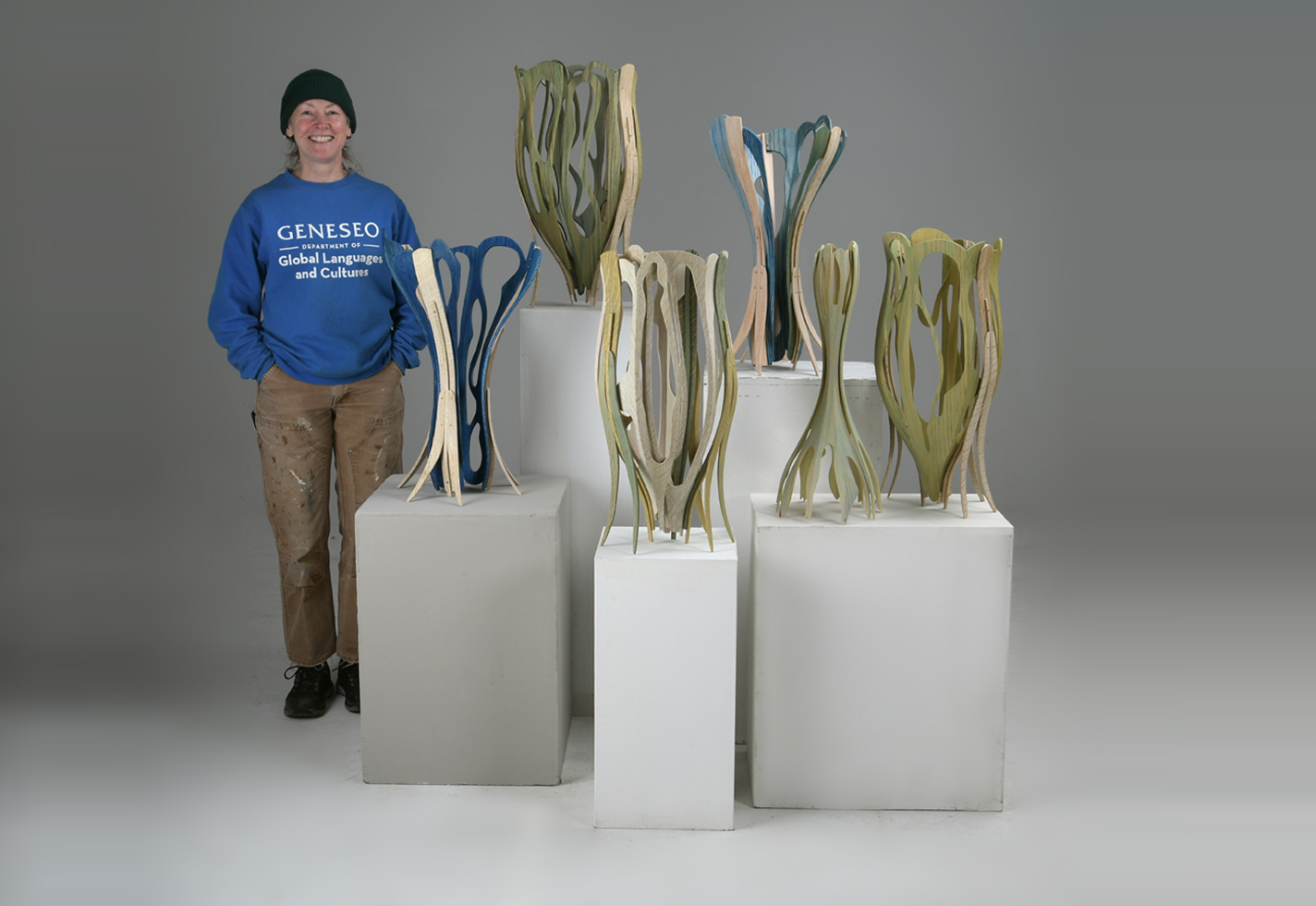
Leah Woods with works from her 2025 series To Cultivate a Garden. Each wood sculpture is approximately 28 x 13 x 13 in.

Leah Woods’s work with the New Hampshire Furniture Masters has brought her from galleries to prison classrooms.

Starting in January 2026, the Fuller Craft Museum in Brockton, Massachusetts, will host Shaping Futures: The Prison Outreach Program of New Hampshire Furniture Masters, an exhibition featuring work by both students and instructors of the organization’s prison woodworking programs in Maine and New Hampshire. Leah Woods is one such instructor: In addition to teaching woodworking and furniture design at the University of New Hampshire, she taught woodworking at the New Hampshire Correctional Facility for Women from 2021 to 2025 (the program is on a temporary pause). Woods found the work deeply rewarding. “This program—and the exhibitions celebrating this work—allows us to be empathetic about this population and consider complex questions and policies around crime, punishment, redemption, and value,” she says. Read more about the exhibition in “Craft Happenings” from the Winter 2026 issue of American Craft, on sale now.

What is your role with the New Hampshire Furniture Masters’s Prison Outreach Program? 

In October 2021, I began teaching woodworking at the New Hampshire Correctional Facility for Women in Concord. I initially inquired about the opportunity in 2009, but it took a class action lawsuit filed in 2012, the construction of a new women’s prison (which opened in 2018), and the disruptions of Covid before our classes began. I taught weekly woodworking classes for approximately two to ten women per class. They learned to carve spoons and to design and build boxes and stools. Almost every student has a specific person for whom they built their projects, whether family or friend. 

Photo by Charley Frieberg

A wood sculpture from Woods's 2025 series To Cultivate a Garden.

What tools are available for incarcerated woodworkers? Are there material limitations on the work you can do in prison woodshops? 

Men’s and women’s prison facilities often offer different resources. While the men’s prison in New Hampshire has a wonderful, fully equipped woodshop, the women’s facility is challenged with space constraints. In the women’s prison, the “woodshop” is in a classroom, which serves a multitude of roles and classes daily, including cosmetology, sewing, and writing workshops. Because of the varied uses, no tools can be stationary. Every tool must be able to be brought into the classroom at the start of class and removed at the end of the night. This dynamic proved too challenging to overcome, and our program is currently on pause as we work with the administration to bring new equipment into the prison.

How does teaching furniture making and art at a university compare to teaching in a prison?

Teaching woodworking at the women’s prison has made me a better teacher in ways I had not anticipated. It is challenging to teach a subject without adequate tools and machines. I thought students would be severely limited and ultimately lose interest in the subject without these resources. I was absolutely wrong. In fact, the excitement students expressed week after week encouraged me to become more flexible in my approach to teaching and to loosen up my own (self-imposed) standards about technical and craftsmanship issues. 

Photo by Richelle Angeli

Leah Woods's student at the New Hampshire Correctional Facility for Women made this in her woodworking class.

“If you popped your head into class, you’d think you were in any college classroom where everyone just happened to be wearing the same thing.”

— Leah Woods

  • Photos by Richelle Angeli

    Works by students at the New Hampshire Correctional Facility for Women.

What are the rewards and challenges of working with incarcerated people?

For four years, students would come to class and say things like, “I’ve been looking forward to this class all week.” At the end of the night, they would leave and say, “See you next week, right?” That level of happiness, interest, and contentment are infectious and gratifying. Each three-hour class was filled with conversation, laughter, and helping each other use tools. I used to describe the classes to people by saying, “If you popped your head into class, you’d think you were in any college classroom where everyone just happened to be wearing the same thing.”

What was the impetus for the exhibition Shaping Futures at the Fuller Craft Museum?

The prison outreach program began at the New Hampshire State Prison for Men in 2001. Since then, we have exhibited furniture made by incarcerated folks at the Furniture Masters Gallery in Concord multiple times. We began our program at the Maine State Prison in 2012, and at the New Hampshire Correctional Facility for Women in 2021. Exhibiting work made in these programs is important because of the dedication students put into their work. This program—and the exhibitions celebrating this work—allows us to be empathetic about this population and consider complex questions and policies around crime, punishment, redemption, and value.

Photo by Richelle Angeli

Works by students at the New Hampshire Correctional Facility for Women.

How do you describe your own work or practice?

Currently, I am building sculptures that are lightweight and delicate. These forms are built with thin, curved pieces of wood. I am trying to create a feeling of strength and resilience embodied in these volumes. Through these ideas, I am interested in exploring the role of beauty found in growth and decoration.

What are you working on right now?

I am working on a four-foot sculpture that is a bulb or root or plant that has not yet grown its leaves and flowers. It is an interconnected web of veins and stems. I am experimenting with the structure to figure out if this bulb is growing and where and how that evidence might be visible.

Which craft artists, exhibitions, or projects do you think the world should know about, and why?

I would encourage people to check out the show Never Not by Aspen Golann and Meghan Samson at Buoy Gallery in Kittery, Maine.

Photo by Charley Frieberg

Works in wood from Woods's series To Cultivate a Garden, 2025.

Shivaun Watchorn is associate editor at the American Craft Council.

Learn more about Leah Woods and the Furniture Masters' Prison Outreach Program.

Leah's Website Prison Outreach Program

Before you go!

We believe that making creates a meaningful world, and we hope you do, too. Deeply researched and impactful journalism on the craft community is in short supply. At the same time, being featured in a national publication can have a major effect on a maker’s or artist’s livelihood, particularly those who are just starting in their career. You can help support our mission and the work of makers around the country by becoming a member or by making a gift today.

Thank you!
American Craft Editors