Craft Around the Country

A Ceramist’s Obsession With Sand

Ariana Kier, a San Diego potter and researcher, finds connections to place through the soil.

By Jacqueline Huynh Young
April 7, 2026

Photo by Jacqueline Huynh Young

Ariana Kier examines soil samples in her San Diego–area home.

Ariana Kier is obsessed with sand. 

Thousands of samples have passed through her hands over the last year alone. They come from estuaries and volcanic regions, glacial deposits and inland deserts. “One of my favorite samples is from Bali,” she says, holding up a vial. 

The grains are so fine and luminous they look like gemstone dust. Some arrive at her desk carefully labeled with latitude and longitude. Others show up in plastic bottles from people’s vacations or stashed in pill vials by collectors whose notes are less precise. Kier, a ceramist and soil cataloguist, archives them one by one in collaboration with Scripps Institution of Oceanography at the University of California, San Diego, where she’s found an ideal home for her longstanding fascination with earth materials. 

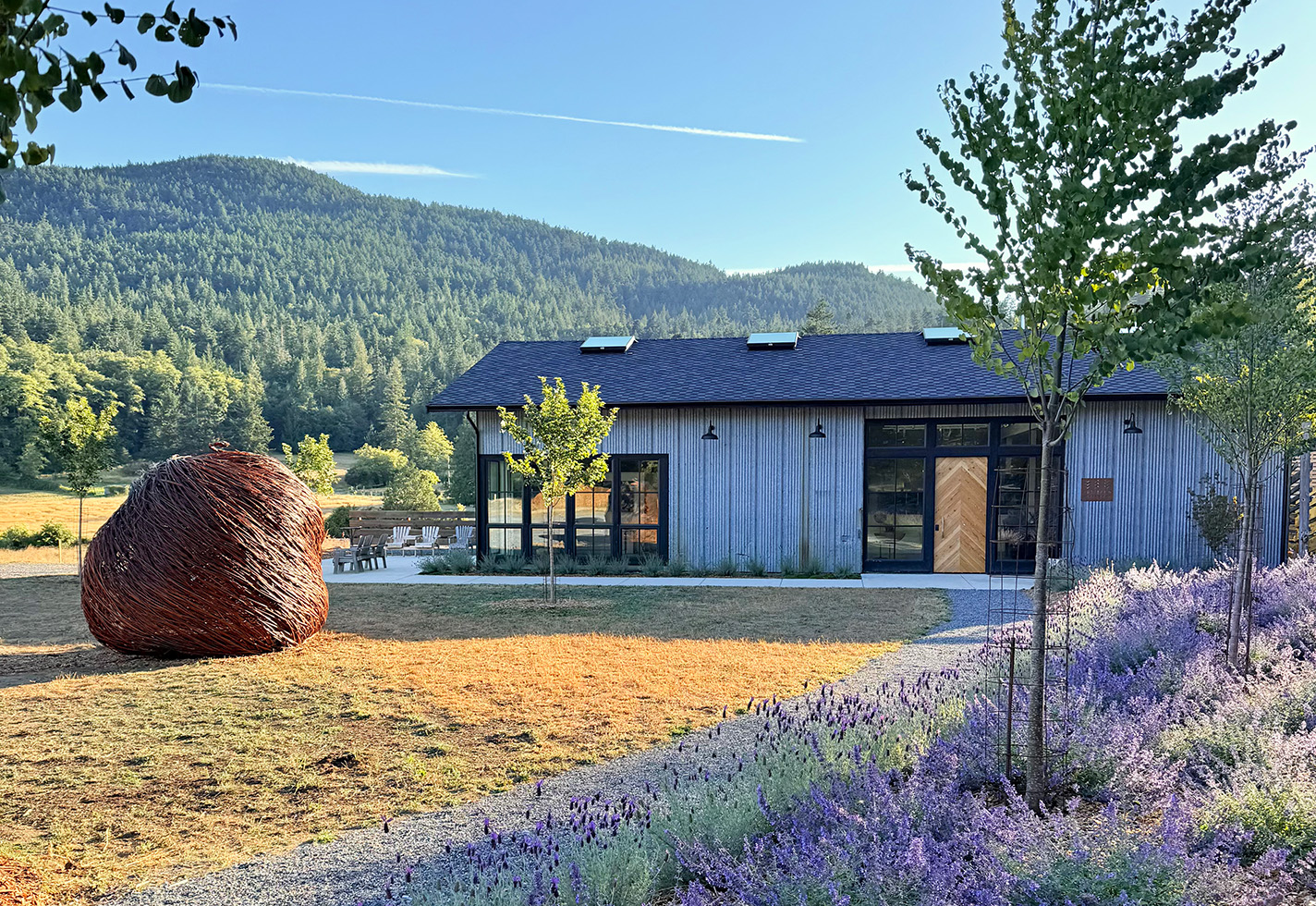
Much of this research extends into her own studio, set among cattle pastures in the rural foothills of the Cuyamaca Mountains in southeastern San Diego County. Kier built the structure with her father on her family’s property beneath the shade of two giant oak trees. Inside, a microscope rests next to test tubes of sand, and ceramic pots bear the marks of her firing tests. Gesturing toward a half-finished window, she says, “The frame. I always meant to put that in.” It’s an idyllic setting that stands in contrast to the typical high-tech laboratory.

Photo by Jacqueline Huynh Young

Kier collects sand from all over the world.

Connecting the Dots 

Kier’s work with Scripps began with a sand archive accumulated through more than a century of donations to the institute. Her friend and research collaborator, Alexandra Hangsterfer, the collections manager for Scripps’ Geological Collections, had inherited the task of organizing the archive, a project that lingered unfinished for decades. Eventually, Kier took over the effort. She built a system to catalog each sample, pairing microscope imagery with geographic data. From a Google Document on her laptop, Kier points to columns of information that carry notes on color, clarity, luster, shape, hardness, and melting point, among other data points. Of notes on the sand’s magnetism, she says, “That one’s just kind of fun.”

Over time, the project took physical shape on a globe, with pushpins dipped in resin and rolled in sand that mark each sample’s point of origin. For Kier, the globe operates as both a scientific tool and a sculpture. Seen from across the room, the pins scatter across its surface like constellations. Up close, the distinctions become clearer: pale coral fragments shaped like starfish, volcanic black crystals that seem to shimmer on their own.

Finding herself in this work feels slightly improbable given her lack of formal education in the subject. “I’m not a geologist,” she says. “I’m just neurotically interested in soil. That’s probably why they let me work here.”


Photo by Jacqueline Huynh Young

Pushpins covered in sand dot a globe in Kier's studio.

“I’m not a geologist, I’m just neurotically interested in soil.”

— Ariana Kier

This archive is built and organized in conjunction with other research she conducts with Hangsterfer. Together, they work with deep-sea sediments used to study ocean acidification and other forms of marine pollution. 

Kier began treating these sediments—which include microscopic matter such as nannofossils and tiny planktonic “sea butterflies” called pteropods—the way a potter approaches glaze materials. She painted them onto porcelain tiles and fired them to different temperatures to see how they would respond in the kiln. One test in particular produced a fluorescent blue glaze, a color rarely found in nature. “For the longest time, we were trying to figure out why these pteropods would turn blue from the heat,” she says.

The answer surfaced unexpectedly through a confluence of seemingly unrelated bits of information. While working at a stone slab gallery, Kier came across a block of blue calcite whose color caught her off guard. “I know calcite is calcium carbonate,” she says. “But I’m looking at it thinking, why is that the exact same blue as in my studio?”

Photo courtesy of Ariana Kier

Marine sediment slip tests on porcelain tiles. These samples were fired at different temperatures from 600C to 1200C.

Around the same time, a friend working for San Diego Coastkeeper, an environmental nonprofit that tracks and challenges threats to the region’s waterways, told her about a lawsuit against SeaWorld. For decades, fireworks displays had been launched over nearby Mission Bay, dropping heavy metals such as copper into the water. As a result, the shellfish had begun absorbing the pollution at levels that made them unsafe to eat. “Somewhere in my brain, those two things connected,” she says. 

The thought sent her back to something she’d seen before: a friend, a mammalian expert at the Natural History Museum in Colorado, had been making copper carbonate from scratch, and its pigment bloomed the same bright blue. That’s when it clicked. 

Further testing confirmed her suspicion. The pteropods in the sediment samples, collected off the coast of Santa Barbara and, by all appearances, far from local mining activity, had been absorbing copper from ocean contamination. When fired in the kiln, the copper oxidized, producing the blue glaze Kier had been seeing.

Photo courtesy of Ariana Kier

Scanning test tiles in Scripps Institute of Oceanography's X-ray fluorescence analyzer.

  • Photos courtesy of Ariana Kier

    Nanofossils within the marine sediments, fired at increasing temperatures and captured via scanning electron microscope.

Learning from the Land

Long before she was working beside oceanographers at Scripps, Kier was learning to read the ground closer to home. As a ceramist working under the name Olla Ceramics, she began harvesting wild clay from her family’s property in rural San Diego County, where fragments of Indigenous olla vessels are occasionally found.

Kier’s first encounter with wild clay happened by accident after moving from New York back to her hometown in her early 20s. When erosion began to threaten the hillside behind her house, her father brought in tractors to cut back the slope. As the earth was peeled away, a 40-foot vein of clay appeared, snaking along the grade. With the help of her father and brothers, she dug out a massive 1,468 pounds of red terracotta, rich in iron, quartz, and mica. Without ever having processed wild clay before, Kier calls the undertaking a “baptism by fire.” 

“My dad and I rented a hand-crank cement mixer, and we had two of these huge grates that we poured for sieving,” she says. “It was an absolute operation.”

Photo courtesy of Ariana Kier

A late-night studio session applying raw marine sediments, kelp ash, and oceanic clay to a piece.

Since then, Kier has harvested clay deposits from across the globe, and, along the way, developed an appreciation for how each site shapes the material. “You start to see the story of a place,” she says. “I have this clay from Nigeria, and it has mica in it. But the mica from there is pink, and the mica from another area is gold.” 

For Kier, each wild clay body boasts a distinct personality, revealing itself the more she works with it. Her local terracotta fires to a deep reddish-orange. It becomes “black when overfired,” she says, “which I sometimes like to do.”

Commercial clay, by comparison, feels strangely anonymous to her, “like a sort of Frankenstein’s monster.” Industrial clay bodies are blended from deposits scattered across multiple regions and processed until their origins disappear. Kier concedes that these blends may make sense in a classroom or production factory, where reliability matters, but in her studio, they feel dislocated, “like someone who’s been pulled from their home.”

Photo by Jacqueline Huynh Young

Completed moon vase by Kier with red deep ocean clay and kelp ash.

Kier is careful to acknowledge that her research exists within a much older lineage of clay practices maintained by Indigenous communities in the region. 

The land surrounding her home lies within the ancestral territory of the Kumeyaay people, whose relationship to clay dates back thousands of years. However much she learns through fieldwork and testing, she sees their traditions as a deeper record of the land. “The Kumeyaay would dig these big water basins. Then they’d line it with clay and set a fire inside. After it was fired, they’d fill it with water, and that would be their trough. It’s genius.” 

Visible from the property’s fence line stands a verdant, grass-covered mountain, an old Kumeyaay site with a cave that once acted as a kiln. “There are thousands of years of anecdotal and observational evidence by this one group of people,” she says. “You’re not going to find more experienced material scientists.”

Photo by Jacqueline Huynh Young

Kier's home sits on ancestral Kumeyaay land in rural San Diego County.

Jacqueline Huynh Young is a Vietnamese American artist and writer based in Los Angeles.

Learn more about Ariana Kier's work online.

Website Instagram

This article was made possible with support from the Windgate Foundation.

Before you go!

We believe that making creates a meaningful world, and we hope you do, too. Deeply researched and impactful journalism on the craft community is in short supply. At the same time, being featured in craft-centered media and articles can have a major effect on a maker’s or artist’s livelihood, particularly those who are just starting in their career. You can help support our mission and the work of makers around the country by becoming a member or by making a gift today.

Thank you!
American Craft Council